
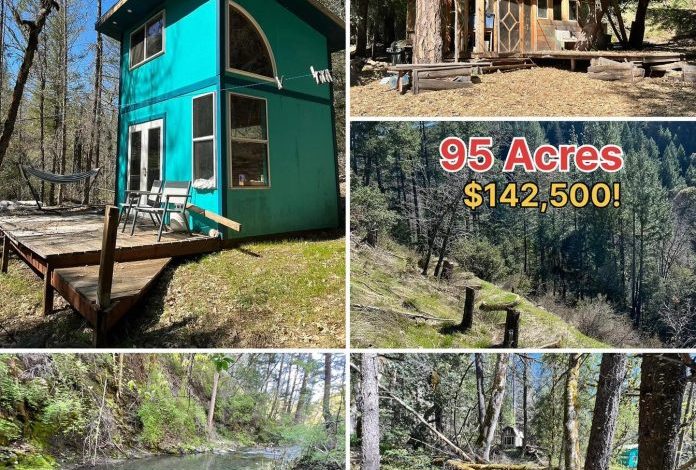
Secluded 95-Acre California Property Features Two Cabins, Water Tanks and Creek Frontage
95-Acre Off-Grid Property in Northern California Listed for $142,500
California real estate is often associated with expensive homes and limited residential land. However, remote areas of Northern California occasionally offer a different type of opportunity: large rural properties with existing structures, natural water features, and the potential for an off-grid lifestyle.
One example is a property at 1500 and 1551 Reading Creek Road in Douglas City, California, listed for $142,500. The property includes approximately 95 acres divided between two parcels, two insulated cabins, several outbuildings, garden areas, workshops, and three large water-storage tanks.
Another notable feature is a year-round creek with approximately 172 feet of reported frontage. The setting is wooded and private, with a mixture of flatter areas, rolling ground, slopes, and steep terrain.
This is not a conventional move-in-ready home, however. The listing classifies the property as unimproved land and reports no installed well, septic system, conventional electricity, or bathroom. Buyers considering it for residential use will need to investigate those limitations carefully.
Property Overview
| Property Detail | Information |
|---|---|
| Location | 1500 & 1551 Reading Creek Road, Douglas City, CA 96024 |
| Asking Price | $142,500 |
| Advertised Acreage | Approximately 95 acres |
| Number of Parcels | 2 |
| Existing Structures | 2 insulated cabins and additional outbuildings |
| Bedrooms Listed | 2 |
| Bathrooms Listed | 0 |
| Creek | Year-round creek |
| Reported Creek Frontage | Approximately 172 feet |
| Water Storage | Three 5,000-gallon tanks |
| Well | Not currently installed |
| Septic | Not currently installed |
| Electricity | No conventional electrical service reported |
| Additional Features | Community kitchen, workshops, gardens, outbuildings |
| Terrain | Flat, rolling, sloped, and steep areas |
| Setting | Rural, wooded, and private |
| Access | Dirt and paved road surfaces; electronic gate reported |
| Listing Classification | Unimproved land |
At $142,500 for approximately 95 acres, the asking price works out to roughly $1,500 per acre. This is a simple calculation based on the advertised acreage and does not represent an independent land valuation.
The property also includes improvements, but their condition, permitting status, and contribution to market value need to be evaluated separately.
Two Parcels With Different Characteristics
One of the most important details is that the advertised 95 acres are divided between two separate parcels.
According to the listing description, the smaller parcel contains a little more than eight acres and includes most of the existing improvements. This is where buyers will reportedly find the cabins, garden areas, workshops, outbuildings, and water-storage tanks.
The larger parcel contains more than 86 acres and is described as steep and heavily wooded.
That distinction matters because the two parcels may serve very different purposes. The smaller property appears to contain the practical infrastructure, while the larger tract may offer additional privacy and recreational opportunities.
Steep terrain can also make construction, driveway installation, utility work, and land management more complicated and expensive.
Before purchasing, buyers should confirm the legal boundaries, access arrangements, ownership details, and development restrictions for both parcels. They should also determine whether the parcels can be used or developed independently.
A Year-Round Creek Adds to the Property’s Appeal
The reported creek frontage is one of the property’s most distinctive features.
The listing describes approximately 172 feet of year-round creek, with photographs showing flowing water, wooded surroundings, and rocky sections.
For someone searching for rural California land with a natural water feature, this could be an important attraction. A creek can contribute to the setting, provide opportunities for enjoying the outdoors, and support local wildlife.
However, owning land alongside a creek does not automatically provide unrestricted water-use rights.
Prospective buyers should investigate riparian rights, water diversion rules, environmental restrictions, flood exposure, erosion, and any applicable setback requirements. They should also establish whether the reported creek frontage is located on the smaller parcel, the larger parcel, or both.
The creek should not be assumed to be an approved source of household water or irrigation without confirming the applicable rights and regulations.
Two Insulated Cabins Already on the Land
Rather than starting with completely undeveloped acreage, buyers will find two existing cabins described as insulated structures.
The supplied photographs show compact wood-finished buildings surrounded by trees. One appears to include a loft sleeping area, windows, and space for basic furnishings.
These structures may provide a useful starting point for someone interested in a recreational retreat or off-grid project. However, they should not be confused with a conventional residential home.
The listing reports zero bathrooms and classifies the property as unimproved land. The legal status of the cabins and their suitability for occupancy should therefore be verified.
A qualified inspector should examine their foundations, roofs, framing, insulation, moisture conditions, electrical components, and general structural condition. Buyers should also ask the county about permits, occupancy requirements, and whether any improvements were constructed without required approvals.
Existing Water-Storage Infrastructure
The property reportedly includes three water-storage tanks, each with a capacity of 5,000 gallons.
Together, they represent up to 15,000 gallons of nominal storage capacity. That figure describes the combined advertised tank capacity, not the amount of potable water currently available.
Buyers should establish where the stored water comes from, how the tanks are filled, whether the system is connected to the cabins, and whether the tanks are in good condition.
The listing also indicates that there is no installed well. Anyone planning regular residential use should investigate the feasibility of drilling one, including local groundwater conditions, permits, estimated costs, and the likelihood of obtaining an adequate supply.
The existing tanks could be useful as part of an off-grid water-management system, but their presence does not eliminate the need to establish a reliable and legally compliant water source.
Workshops, Community Kitchen and Garden Areas
Another interesting part of the property is the collection of additional improvements.
The listing describes a community kitchen, indoor and outdoor workshop areas, multiple outbuildings, and established garden infrastructure.
Photographs show raised garden beds and hoop-style frames in a cleared area. These could provide a starting point for buyers interested in growing vegetables or developing a small homestead.
However, the actual productivity of the garden area will depend on sunlight, soil quality, irrigation, growing conditions, and wildlife pressure.
The workshop areas may also be useful for storage, repairs, and maintaining equipment. Their condition, electrical arrangements, dimensions, and permitted uses should be confirmed during an inspection.
As with the cabins, buyers should not assume that every existing structure has the necessary permits or approval for its current use.
No Conventional Electricity, Well or Septic System
The property’s off-grid character is also one of its biggest challenges.
According to the supplied listing details, conventional electricity is not currently installed. A well is also absent, and no septic system is listed.
The property therefore requires additional investigation before anyone assumes it can support full-time residential living.
Potential solutions could include solar power with battery storage, a generator, a permitted septic system, an approved composting toilet, and a reliable water source. The appropriate setup will depend on local regulations, site conditions, and the buyer’s intended use.
The cost of installing these systems can vary considerably. Soil conditions, terrain, distance from existing infrastructure, permitting requirements, and contractor availability can all influence the final budget.
Buyers should obtain site-specific estimates rather than relying on generic installation figures.
Could Solar Power Work Here?
Solar energy may be worth investigating because the property does not have conventional electrical service.
A properly designed system could potentially provide electricity for lighting, refrigeration, water pumping, communications, and other household needs.
However, the heavily wooded setting creates an important consideration: available sunlight.
The location of the cabins, surrounding tree cover, seasonal shading, slope, and expected electricity consumption will influence whether solar is practical and where panels could be installed.
A professional assessment should determine the appropriate system size, battery capacity, and backup requirements. Buyers should also compare the cost of solar against any available option for extending grid service.
The presence of a large amount of acreage does not automatically make a property suitable for solar installation. The actual usable area and sunlight exposure matter much more.
Privacy and Remote Northern California Living
The listing describes the property as private and secluded, with access through an electronic gate.
The surrounding photographs show wooded hills, mature trees, and cabins separated from the typical residential setting.
For buyers seeking a rural retreat, that level of separation may be appealing. The property could provide space for outdoor activities, gardening, workshops, and recreational use.
But remote living also brings practical responsibilities. Buyers should consider travel distances to groceries, medical services, employment, emergency responders, and other everyday necessities.
They should also confirm whether the access road is legally established, who maintains it, and whether it remains passable during different seasons.
An electronic gate may provide controlled entry, but it does not by itself establish legal access rights or guarantee that emergency vehicles can reach the property.
Steep Terrain and Wildfire Considerations
The listing describes a combination of flat, rolling, sloped, and steep land.
The larger parcel, reportedly containing more than 86 acres, is particularly steep and wooded. That may provide additional separation from neighboring properties, but it could limit the amount of land suitable for construction or intensive use.
Before assigning value to the entire acreage, buyers should identify the flatter and more accessible portions of both parcels.
Northern California buyers should also investigate wildfire exposure. Important considerations include vegetation management, defensible space, emergency evacuation routes, road access, and insurance availability.
Insurance quotes should be obtained before closing. Some rural properties can be difficult or expensive to insure, particularly when structures are remote or lack conventional utilities.
Listing Price History
The supplied listing history shows that the property was previously marketed at higher asking prices.
| Listing Period | Reported Asking Price |
|---|---|
| 2023 | $180,000 |
| 2024 | $168,000 |
| 2025 | $158,000 |
| April 2026 | $142,500 |
Compared with the earlier $180,000 asking price, the current $142,500 price represents a difference of $37,500, or approximately 20.8%.
It is important to distinguish asking-price changes from completed sales. A reduction in the advertised price does not establish that a property is undervalued or that the seller has accepted a lower offer.
Buyers should compare the current asking price with recent completed sales of similar rural acreage in the area, particularly properties with creek frontage, cabins, and existing improvements.
Why the Price-Per-Square-Foot Figure Is Misleading
Automated real estate information may display a price-per-square-foot figure of approximately $20,357 for this property.
That number appears to be based on the reported seven square feet of interior living area. Dividing $142,500 by seven produces approximately that figure.
However, it is not a meaningful way to evaluate a property marketed primarily as 95 acres of rural land with cabins and outbuildings.
A more useful assessment would consider the acreage, terrain, usable land, creek frontage, access, structures, water infrastructure, permitting status, and comparable local land sales.
The reported seven-square-foot figure should also be clarified with the listing agent because it does not appear to represent the actual size of the two cabins.
Financing and Ownership Costs
Financing this property may be different from financing a conventional home.
Because it is classified as unimproved land and reportedly lacks standard utilities and a bathroom, some traditional residential mortgage programs may not be suitable.
Potential buyers should speak with lenders who handle rural land or recreational properties. They should confirm whether the property qualifies for financing, what down payment may be required, and whether the existing structures affect underwriting.
The purchase price is also only one part of the ownership cost.
Additional expenses may include:
- Closing costs and financing fees
- Septic installation or an approved alternative sanitation system
- Solar panels, batteries, or generator equipment
- Well drilling or another permitted water solution
- Repairs to cabins and outbuildings
- Road maintenance and access improvements
- Wildfire insurance and vegetation management
- Property taxes and ongoing maintenance
The total investment will depend heavily on whether the buyer intends to use the property in its current recreational form or make substantial improvements.
Could This Property Work as an Off-Grid Homestead?
The property has several features that could appeal to someone interested in developing an off-grid homestead.
The existing cabins, garden areas, workshops, water-storage tanks, creek, and large acreage provide a starting point for further planning.
However, a homestead requires more than land and existing structures. Reliable water, sanitation, electricity, suitable growing areas, legal residential use, and practical access are essential considerations.
The steep terrain may also limit how much of the advertised acreage can be used for gardening, additional buildings, or other improvements.
Anyone planning permanent occupancy or further construction should consult Trinity County about zoning, building permits, sanitation requirements, and the legal status of the existing structures before making an offer.
Main Advantages and Potential Drawbacks
The strongest attractions include the approximately 95 acres, two insulated cabins, reported year-round creek, three large water tanks, garden infrastructure, workshops, outbuildings, and secluded setting.
The main limitations are equally important. There is no listed well, septic system, bathroom, or conventional electrical service. The larger parcel is reportedly steep, and the existing cabins and other improvements require verification of their condition and legal status.
Creek-use rights, water availability, wildfire exposure, insurance, financing, and legal access should all be investigated.
This is not simply a matter of comparing the asking price with the advertised acreage. The condition and usability of the improvements, as well as the cost of establishing essential services, will have a major influence on the property’s overall value.
Buyer Due Diligence Checklist
Before purchasing, prospective buyers should:
- Review both parcels: Confirm legal descriptions, acreage, boundaries, ownership, and access rights for each parcel.
- Verify cabin permits: Establish whether the cabins and other structures were legally constructed and what uses are permitted.
- Investigate water rights: Confirm the legal rights associated with the creek and any potential water diversion or use.
- Inspect the storage tanks: Verify their condition, capacity, water source, plumbing, and suitability for the intended use.
- Evaluate well feasibility: Obtain professional guidance on drilling costs, groundwater conditions, and permitting.
- Investigate sanitation: Determine whether a permitted septic system or approved alternative can be installed.
- Assess solar potential: Review sunlight exposure, tree cover, system placement, and expected electrical demand.
- Inspect access: Confirm road ownership, maintenance responsibilities, seasonal conditions, and emergency access.
- Review wildfire exposure: Investigate fire risk, defensible-space requirements, evacuation routes, and insurance availability.
- Compare local sales: Evaluate recent completed sales of similar acreage and recreational properties rather than relying only on previous asking prices.
Final Thoughts
Listed for $142,500, this approximately 95-acre property in Douglas City, California, offers an unusual combination of rural land and existing off-grid improvements.
The two insulated cabins, year-round creek, three 5,000-gallon water tanks, garden areas, workshops, and outbuildings provide several features that may appeal to someone looking for a private recreational property or a potential homestead project.
However, the absence of a well, septic system, bathroom, and conventional electricity means that buyers should approach the listing with a realistic improvement budget. The steep terrain, two-parcel layout, wildfire exposure, and legal status of the existing structures also deserve careful attention.
For someone comfortable with remote property ownership and the additional work involved in developing an off-grid setup, this could be an interesting Northern California property to investigate.
For additional information, contact the listing agent through the Zillow link below the photos.
Disclaimer: This article is for informational purposes only and does not constitute real estate, legal, financial, tax, or investment advice. Property details, acreage, boundaries, price, availability, water rights, permits, structures, and utilities should be independently verified with the listing agent, qualified professionals, and relevant local authorities before making a purchase decision.


Listed on Zillow


