A Police Officer Made My 73-Year-Old Father Sit Beside His Broken Truck for Nearly an Hour—Then Dad Asked Him to Call the Fire Station
My father, Walter, is seventy-three years old.
He has lived in the same small town for almost fifty years, drives the same old Ford pickup he bought after retirement, and refuses to replace anything that can still be repaired.
One July afternoon, I was riding with him to my sister’s house when the truck suddenly began making a terrible noise.
Dad immediately pulled onto the shoulder.
Steam started coming from beneath the hood.
“Radiator hose,” he said calmly.
Before I could even get out, a police cruiser stopped behind us.
The officer who stepped out looked young. Maybe twenty-five.
“License and registration.”
Dad handed them over.
“We’re broken down, Officer. I think a hose blew.”
The officer looked at the truck, then at Dad.
“Step away from the vehicle.”
Dad obeyed.
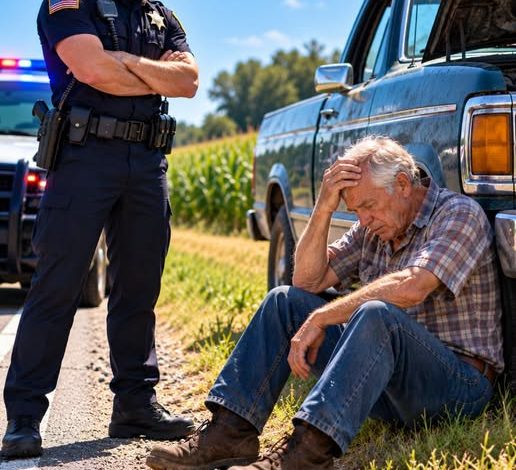
It was brutally hot outside. The temperature was over ninety degrees, and there wasn’t a tree anywhere near us.
I asked if Dad could wait inside the truck.
“No. He stays where I can see him.”
The officer returned to his air-conditioned cruiser.
Ten minutes passed.
Then twenty.
At thirty minutes, Dad asked politely, “Officer, may I sit down somewhere?”
“You can wait.”
So my seventy-three-year-old father lowered himself onto the edge of the ditch.
I was furious.
But Dad remained strangely calm.
Almost too calm.
After nearly an hour, the officer finally returned.
“I can’t verify some information connected to this vehicle,” he said. “I’m considering having it towed.”
Dad looked at him for several seconds.
Then he noticed the radio clipped to the officer’s shoulder.
“Would you mind doing me one favor?”
“What?”
“Call Station 4.”
The officer frowned.
“The fire station?”
“Yes.”
“Why?”
Dad smiled slightly.
“Just tell them Walter Hayes is sitting beside his truck on Miller Road.”
The officer looked confused, but eventually pressed his radio.
“Dispatch, can you contact Station 4? I’ve got a Walter Hayes out here on Miller Road.”
There was silence.
Then the radio crackled.
“Repeat that name.”
The officer looked at Dad.
“Walter Hayes.”
Another pause.
Then someone answered.
“Is Walter okay?”
The officer’s expression changed.
Before he could respond, another voice came over the radio.
“Tell Walter we’re coming.”
Dad sighed.
“You don’t have to come.”
But it was already too late.
Within fifteen minutes, a fire department pickup appeared.
Then another.
Three firefighters climbed out.
The oldest one walked directly past the officer and hugged my father.
“Walter, what happened?”
“Truck broke down.”
The firefighter looked toward the officer.
“And why have you been sitting out here?”
Dad tried to dismiss it.
“Just a misunderstanding.”
But I didn’t.
“He’s been sitting in this heat almost an hour.”
The firefighter’s expression hardened.
The young officer looked completely confused.
“Who is he?”
The firefighter stared at him.
“You seriously don’t know?”
Then he pointed toward my father.
“That man was our fire chief for twenty-eight years.”
I had heard the stories growing up.
But even I didn’t understand what Dad had meant to that town.
Then another firefighter spoke.
“When I was nineteen, my house caught fire. Walter went inside because he thought my little brother was still upstairs.”
Another man stepped forward.
“He pulled my wife from a wreck during a snowstorm.”
Then the oldest firefighter said something that silenced everyone.
“And twenty-two years ago, he saved your father’s life.”
The officer froze.
“My father?”
Dad finally looked closely at the officer’s name badge.
His expression changed.
“Your last name is Collins?”
“Yes.”
Dad nodded slowly.
“David Collins is your father?”
The young officer stared at him.
“Yes.”
Dad looked down at the ground.
“I remember that night.”
The officer didn’t move.
Years earlier, his father had crashed his car into a flooded creek during a storm.
Dad had been one of the first firefighters there.
The water was rising quickly.
Everyone had been told to wait for rescue equipment.
Dad didn’t.
He tied a rope around himself and entered the water.
He got David Collins out.
The young officer looked like someone had knocked the air from his lungs.
“My dad told me about that accident.”
Dad nodded.
“He was lucky.”
“He told me a firefighter saved him.”
Dad smiled.
“There were a lot of us there.”
The officer’s eyes filled with tears.
“He never told me your name.”
Dad shrugged.
“He didn’t need to.”
For the first time all afternoon, the officer stopped acting like a policeman and looked like a young man who suddenly realized he’d made a terrible mistake.
“Mr. Hayes… I’m sorry.”
Dad stood slowly.
Then he said something I’ll never forget.
“Don’t apologize because you found out who I am.”
The officer looked at him.
“Apologize because you would’ve treated me differently if you’d known.”
Nobody spoke.
Dad pointed toward the highway.
“The next old man you stop might never have been a fire chief. He might never have saved anybody. He still deserves a chair when it’s ninety degrees outside.”
The officer lowered his head.
“You’re right.”
The firefighters repaired Dad’s radiator hose right there on the roadside.
Before we left, the young officer approached him again.
This time Dad shook his hand.
Six weeks later, Dad received a letter.
It was from Officer Collins.
He wrote that since that afternoon, whenever he stopped an elderly driver, he heard Dad’s words in his head.
At the bottom he’d written:
“I thought respect was something people earned by what they’d done. You taught me that dignity is something we owe people before we know their story.”
Dad read the letter twice.
Then he folded it and placed it inside the kitchen drawer where he keeps important things.
He never displayed it.
Never told anyone about it.
That’s just who my father is.
But every time I drive down Miller Road now, I remember seeing him sitting beside that broken truck in the heat.
And I remember what he taught all of us that afternoon:
You shouldn’t have to discover someone’s importance before deciding to treat them like they matter.