
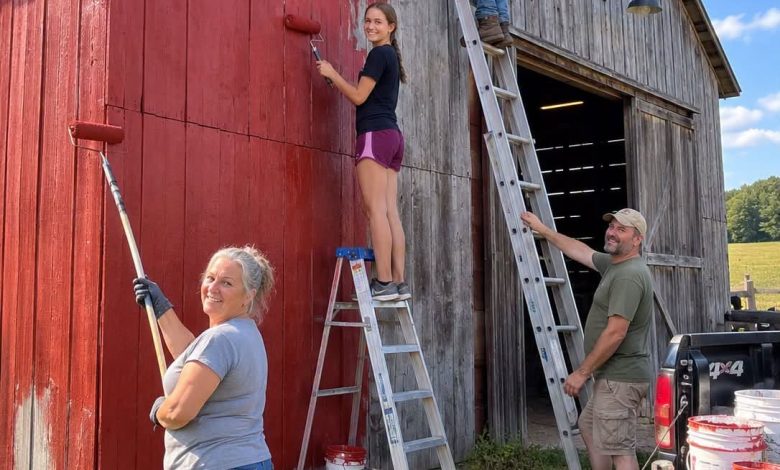
While My Husband Recovered From a Stroke, My Son Painted Our 100-Year-Old Red Barn Gray So I Brought 40 Gallons of Red Paint Home
I saw it in my headlights on a Thursday night in September.
I was coming up our lane at a quarter to ten with a bag of dirty hospital laundry on the seat beside me.
The yard light was on, the way it always is. It throws a white circle across the gravel and climbs halfway up the south wall of the barn.
And the wall it climbed was gray.
Not old gray. Not weathered gray. New paint. Flat and even. Laid right over the old boards.
I stopped the car in the middle of the lane with the engine still running.
I sat there with both hands on the steering wheel. And I looked at it for a long time.
That barn was built in 1925 by my husband’s grandfather, Walter Jensen. With lumber hauled from the train depot in Tracy, Minnesota, on a hay wagon pulled by two Belgians.
It had been red every single day since.
It was red when Arlo’s father, Earl, milked forty Holsteins in it.
It was red the day Arlo and I got married and had our wedding pictures taken in front of the big sliding door.
It was red in every Christmas card we ever mailed. It was red in the framed photo hanging in the hallway of the Lyon County fair office, from the year Arlo’s steer took reserve champion.
And now it was gray.
And I’d been gone for eleven days.
My name is Carol Jensen. I’m fifty-eight years old. I’ve been married to Arlo Jensen for thirty-seven years. We farm three hundred and twenty acres of corn and soybeans on a county road outside Tracy, in the southwest corner of Minnesota.
And I need to tell you where I’d been for those eleven days.
Because people always ask me why I didn’t just stop it.
On the last Saturday of August, my husband stood up from the supper table to get more coffee.
And his right hand wouldn’t close on the coffee pot.
He looked down at his hand like it belonged to somebody else.
Then he turned and tried to say my name.
What came out wasn’t my name. It wasn’t any word at all.
I’m a farm wife. I’ve called the ambulance for a man pinned under a tractor. I’ve called it for a neighbor kicked in the chest by a cow.
I knew exactly what I was looking at.
I had 911 dialed before he hit the kitchen floor.
The ambulance took him to the hospital in Marshall. From there, they flew him by helicopter to Sanford in Sioux Falls.
I drove the seventy miles behind that helicopter in the dark. I had the radio off. I don’t remember one single mile of that drive.
It was a stroke. On the left side of his brain.
That’s the side, the doctor told me, that runs the right hand. And most of the words.
Four days in intensive care.
Then they moved him up to the rehabilitation floor. Where they teach grown men to walk again. To button a shirt. To say the word cup.
I slept in a vinyl chair that folded out about as far as a lawn chair. I ate out of the vending machine. And out of the cafeteria, when I remembered to.
I watched my husband, a man who could back a gooseneck stock trailer into a slot with two inches to spare on either side, work for twenty minutes to pick up a plastic spoon.
I wouldn’t have left that room for anything in this world.
And I didn’t. Not until the nurses made me.
“Carol. Go home for one night,” the charge nurse finally said on the eleventh day. Her name was Lorraine. She’d been a nurse for thirty years and didn’t take no for an answer. “Sleep in your own bed. Bring him his own pajamas. He’ll be right here when you get back.”
So I drove home that Thursday night.
And the barn was gray.
I got out of the car and stood there in the gravel. I could smell it then. That sharp, clean smell of fresh paint still curing in the cool night air.
The trim was gray too. A shade darker. The big sliding door. The haymow door. The little window on the north end where the barn cats like to sleep.
All of it.
Gray.
I called my son standing right there in the lane.
Brad’s our only child. He’s thirty-four. He’s married to a sweet girl named Brooke. He sells real estate out of an office on Main Street in Marshall.
He answered on the second ring.
“Mom? Is Dad okay?”
“Dad’s the same,” I said. “I’m home for the night. I’m standing in the yard.”
There was a little pause.
And then his voice got brighter.
“Oh, good. You saw it.”
He sounded proud.
That’s the part that took my breath away. He sounded like a little boy who’d cleaned out the garage without being asked and was waiting for somebody to notice.
“A client of mine runs a spray crew out of Worthington,” Brad said. “They did the whole thing in two days. Four thousand dollars, Mom. That’s a favor price. They’d charge anybody else nine.”
“Four thousand dollars,” I said.
“I paid it. You don’t owe me anything. I just wanted to get ahead of things.”
“Ahead of what, Brad?”
“The listing.”
He said it like it was all settled. Like we’d talked it all over at Sunday dinner.
“Buyers want gray right now. Gray and white. That’s what’s selling. Red barns read old in the pictures.”
“What listing, Brad?”
“Mom.”
He said it gently. The way you’d talk to somebody who’s had a very long day and isn’t thinking straight.
“You can’t run three hundred and twenty acres by yourself. And Dad isn’t going to be able to. I’ve got a photographer coming out Monday morning. I’m just trying to help.”
I had never said one single word to anybody about selling our farm.
Not to Brad. Not to Arlo. Not to our pastor. Not to myself, at three in the morning in that hospital chair.
I want to be honest about what I felt.
My first feeling wasn’t anger.
It was something more like being robbed in my sleep.
My second feeling was anger. And I held onto it with both hands.
Because Arlo’s hospital room was seventy miles away. And when I went back, he’d be able to hear every word I said into a phone from that vinyl chair.
His speech therapist told me the week before that Arlo understood almost everything. The words were all in there. They just couldn’t get out to meet us.
I wasn’t going to bring a fight with our son into that room.
I wasn’t going to have it out in the hallway outside his door, where Arlo could hear our voices through the wall and not be able to say one thing.
“Thank you for telling me, Brad,” I said.
“So you’re okay with it?”
“I’m going to bed, Brad. I’m tired. Good night.”
He started to say something else.
And I hung up on him.
I had never once hung up on my son. Not in thirty-four years.
I didn’t go to bed.
I walked out to the barn in my church shoes. The same navy flats I’d been wearing for eleven days, because I’d packed for the hospital in such a hurry I forgot sneakers.
The gravel turned to grass. The grass was wet. I walked the whole way around that barn with the flashlight from my glove box.
They’d done a clean job. I’ll say that for them. Every board was covered, top to bottom. There wasn’t a single drip on the old fieldstone foundation.
On the north side, the old boards were still warm from the day’s sun.
I put my hand flat against one. The way you’d put your hand on the neck of a horse.
Then I went around to the east end. And I shined the flashlight up at the haymow door.
And I found the thing that made me sit down right there in the wet grass.
Arlo’s father, Earl, painted that barn himself in the summer of 1958. By hand. With a brush. It took him all of July.
When he finished, he climbed up a ladder with a little can of white paint. And above the haymow door, he painted his initials. With the year underneath.
E.J. 1958.
Two letters and four numbers. About a foot tall. A little crooked, because he did them hanging off a ladder with a sash brush.
When Brad was little, Arlo used to lift him up on his shoulders out in the yard so he could see those letters.
“That’s your grandpa up there,” Arlo would tell him. “He climbed all the way up there when he was older than I am now.”
Brad would wave at the letters. He was three. Maybe four.
He thought his grandpa lived up there.
Those letters were gone.
There was nothing above the haymow door anymore. Just smooth, flat gray.
I sat down in that wet grass for a long time.
I’m not ashamed to tell you I cried.
And it wasn’t about the color of a barn.
It was about a photographer coming on Monday.
It was about my son deciding, in the eleven days I’d been sitting beside his father’s bed, that his father wasn’t coming home.
And it was about how close he might be to right.
Because I didn’t know yet if Arlo would ever walk again.
I didn’t know if he’d ever say my name again.
When I finally got up, my slacks were soaked through.
And I’d decided something.
I wasn’t going to call that spray crew in Worthington and yell at them.
I wasn’t going to call Brad back and say all the hard things I had ready on my tongue.
I was going to paint it back.
I went inside and found Arlo’s old Stanley tape measure in his desk drawer. And at eleven o’clock at night, I went back out and measured that barn by flashlight.
Seventy-two feet long. Thirty-six feet wide. Sixteen feet up the walls to where the roof starts. And the big gambrel ends going up another twenty feet to the peak.
I sat at the kitchen table with a pencil and the back of an envelope from the electric co-op.
I’m not a painter. But I’ve kept the books on this farm for thirty-six years. I can do arithmetic.
It came to somewhere around forty-five hundred square feet of siding. Not counting the doors.
Then I took a long, hot shower. And I slept four hours in my own bed, next to Arlo’s empty pillow.
It was the best sleep I’d had since August.
At seven o’clock Friday morning, I was sitting in the parking lot of Runnings farm store in Marshall when they unlocked the doors.
The paint counter is run by an older man named Gene Haugland. He’s been mixing paint there since before they built the new store. He’s sold Arlo fence paint and stock tank paint for twenty years.
“Carol,” Gene said when he saw me. “How’s Arlo?”
“Working hard,” I said. “Gene, I need barn paint. Red. The real red.”
I slid my electric bill envelope across the counter with all my numbers on it.
Gene looked at it. He pushed his glasses up on his nose.
“That’s the old Jensen barn,” he said. “On the county road.”
“It was red until Tuesday.”
He knew. Of course he knew. Everybody who drives that county road had gone past it. And half of them had probably called Gene to ask what in the world was going on out at the Jensen place.
“Rough-sawn boards drink paint like a dry cow drinks water,” Gene said. He tapped my envelope with his finger. “Figure a hundred and fifty, two hundred square feet a gallon. One coat. Going red over fresh gray, one good coat’ll cover. If you back-brush it.”
“So thirty gallons?”
“Thirty, if nobody spills.” He looked at me over his glasses. “Get forty. You’ll have kids, I’m guessing?”
I hadn’t told him that.
I hadn’t told anybody that. I hadn’t even thought it yet.
“You’ll have kids,” Gene said again.
And he started pulling five-gallon pails off the pallet.
Eight five-gallon pails of barn red. A hundred and seventy-seven dollars each.
Two gallons of white for the trim. Rollers with thick one-inch nap for rough wood. Extension poles. Brushes. Paint trays. A box of rags. A case of canvas drop cloths.
It came to a little over seventeen hundred dollars.
I paid it out of our household account. The one Arlo and I have kept at the same little bank in Tracy since 1989.
The boy who loaded those pails into the back of Arlo’s pickup was maybe seventeen.
“Painting a barn, ma’am?”
“Painting it back,” I said.
He didn’t ask what I meant. And I didn’t explain.
I sat in the pickup in the Runnings parking lot, and I called Nate.
Nate Ellison is the youth pastor at our Methodist church in Tracy. He’s twenty-nine. He has a beard he’s still growing into. And he drives a minivan with a big dent in the sliding door that the youth group kids are not allowed to mention.
He’d driven to Sioux Falls twice to pray with Arlo.
The second time, Arlo grabbed Nate’s hand with his good left hand and wouldn’t let go for twenty minutes.
“Nate,” I said. “How many kids could you get on a Saturday? All day? If I fed them?”
He didn’t even ask what for.
He’d driven past the barn on Wednesday. Everybody had.
“Let me make some calls, Carol,” he said. “I’ll ring you back.”
He called back in one hour.
“Twenty-two kids,” he said. “And four dads with extension ladders. And Carol? I need to tell you exactly how we’re going to do this. So nobody’s mom calls me on Sunday.”
I liked him a great deal right then.
Nate had rules. He read them to me over the phone like a man who’d already thought about this a lot.
Every kid would have the church activity form signed by a parent. No exceptions.
Nobody under sixteen would go up a ladder. Period. The younger kids would roll the bottom eight feet from the ground, with rollers on poles. And there was plenty of bottom eight feet to go around.
The older kids could work ladders. But only up to the first floor. And only with Nate running the ladders and watching every single one the whole time it had a kid on it.
No kid would ever be on a ladder alone.
“And the peaks?” I asked. “Those gambrel ends go up thirty-six feet, Nate.”
“Nobody’s going up there on a ladder,” Nate said. “Not a kid. Not me. Not anybody. You need a lift.”
So I called Merle.
Merle and Pam Rasmussen have farmed the place across the county road from us for as long as we’ve farmed ours.
Merle and Arlo have traded work every single fall for thirty years. Combining. Hauling. Fixing fence.
Merle had driven to Sioux Falls three times. And the day after Arlo’s stroke, he drove his own combine across the road and started on our soybeans. Without asking anybody.
He won’t let me pay him a dime.
“I’ll rent a lift from the rental place in Marshall,” Merle said. “The towable one. Forty-five foot. I’ll run it myself. Me and Nate and Mike Olson. Nobody else goes up in that basket.”
“Let me pay for the lift, Merle.”
He was quiet for a second.
“You can pay for the lift,” he said.
And that’s how I knew how bad he felt about that gray.
The rental was three hundred and fifty dollars for the day. I paid it. I was glad to.
That afternoon, I drove back to Sioux Falls with Arlo’s own flannel pajamas. His reading glasses. And the pillow off his side of our bed.
When I got to the rehab floor, he was in the therapy gym. Standing between the parallel bars, with a young therapist holding a gait belt around his waist.
He took four steps.
Then three more.
When he saw me in the doorway, his face did the thing it does now. One side smiled all the way up. The other side tried.
“Car,” he said.
That’s what he calls me. Not Carol. Car. He’s called me that since we were nineteen years old, dancing at the Legion hall in Walnut Grove.
It was one of the very few words that had come back.
I didn’t tell him about the barn.
I’d thought about it the whole drive over. In thirty-seven years of marriage, I’d told Arlo every single thing. Down to the price of hamburger at the Cash Wise.
But he was standing between those parallel bars working harder than I’ve ever seen any man work at anything.
And I couldn’t hand him one more thing to carry that he couldn’t lift.
So I told him the soybeans looked good and Merle was on them.
I told him the barn cats were getting fat.
I told him Brad said hello. Which was true.
I slept in the vinyl chair that night.
At four in the morning, I kissed his forehead while he was sleeping. And I drove home in the dark.
To paint a barn.
The first minivan came up our lane at seven-thirty Saturday morning.
By eight o’clock, there were cars parked all the way down the grass along our driveway. And twenty-two teenagers standing in my yard in old T-shirts and ratty sneakers.
It was one of those September mornings Minnesota gives you right before it takes everything back. Blue sky. No wind. The beans across the road just starting to turn yellow at the edges.
Nate stood up on the tailgate of Arlo’s pickup and gave the safety talk.
The kids listened better than I expected. A couple of the older boys rolled their eyes at the part about ladders. Nate just looked at them until they stopped.
Then he said a short prayer. For the work. And for Arlo.
Twenty-two kids bowed their heads in my yard with paint rollers in their hands.
I had to walk around to the other side of the pickup for a minute.
Merle had the lift set up on the east end by eight-fifteen. He put the outriggers down on wide boards so they wouldn’t sink into the soft ground. He and Mike Olson went up first, cutting in along the roofline with brushes.
The four dads set up their extension ladders along the south side. The older kids went up two rungs at a time with a roller and a small bucket. And Nate ran the ladders. Moving down the line. Always with one hand on the rail of whichever ladder had a kid on it.
The younger kids worked the bottom with rollers on long poles.
And I stirred paint. And poured it into trays. And moved from one end of that barn to the other like a woman serving supper to a threshing crew.
Gene had been right about back-brushing.
The kids would roll a section. And then somebody would come right behind with a wide brush and work the paint down into the rough grain of the boards.
And the gray just disappeared under it.
You could watch it go. Board by board. Like a cloud shadow sliding off a field when the sun comes out.
By ten o’clock, the bottom of the whole south wall was red.
And it was the right red. Not fire-engine red. Not brick red. Barn red. That deep, old color that looks almost brown in the evening light.
Some of those kids I knew. The Peterson twins. Hannah, who works at the Dairy Queen. A tall, quiet boy named Tyler whose grandfather used to haul our cattle to the sale barn in Worthington.
Most of them I didn’t know at all.
They were somebody’s grandchildren from church. They’d never set foot on our place in their lives.
And they’d given up a Saturday in September to paint a barn for a woman they’d never met.


