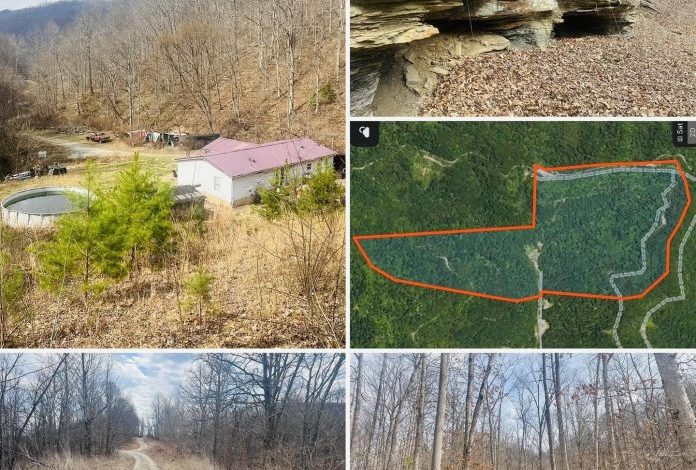
170 Wooded Acres Near Pikeville, KY, with Manufactured Home and ATV Recreation Nearby
170 Acres with Manufactured Home and Natural Springs Listed for $250,000 in Eastern Kentucky
Large wooded properties with an existing residence, electrical service and established access can attract considerable interest from buyers searching for recreational acreage or a future rural homestead. In eastern Kentucky, a 170-acre property near Pikeville offers that combination, along with natural springs, wooded mountain terrain and a manufactured home.
Located at 1470 Hopkins Fork, Pikeville, KY 41501, the property is listed for $250,000. The residence is described as a 1,248-square-foot manufactured home built in 1995, with three bedrooms and two bathrooms. The land includes wooded slopes, creek bottoms and mature hardwood trees, while the existing infrastructure reportedly includes electricity, a private septic system and a cistern.
The property is also being marketed for its proximity to ATV recreation, including the Hillbilly Trails area. However, buyers should carefully distinguish between nearby recreational attractions and any direct access or usage rights that actually come with the land.
At approximately $1,471 per acre when the total asking price is divided by the advertised acreage, the property may attract attention from buyers looking for substantial Kentucky land. But the manufactured home’s condition, water arrangements, terrain, access and development restrictions all deserve closer examination.
Property Overview
| Property Detail | Listing Information |
|---|---|
| Asking Price | $250,000 |
| Location | 1470 Hopkins Fork, Pikeville, KY 41501 |
| County | Pike County |
| Total Acreage | Approximately 170 acres |
| Property Type | Manufactured home with acreage |
| Living Area | Approximately 1,248 sq. ft. |
| Bedrooms | 3 |
| Bathrooms | 2 full bathrooms |
| Year Built | 1995 |
| Foundation | Pillar/post or pier foundation, according to supplied information |
| Exterior | Vinyl siding |
| Roof | Metal |
| Heating | Forced-air propane |
| Cooling | Window units |
| Water | Cistern system and natural springs reported |
| Sewer | Private septic system reported |
| Electricity | Connected service reported |
| Land Features | Wooded mountains, creek bottoms and mature hardwoods |
| Restrictions | Described as unrestricted; verify independently |
| HOA | None reported |
Details are based on the supplied property information and should be confirmed through the listing agent, county records and appropriate inspections.
170 Acres Are the Main Attraction
The acreage is likely to be the property’s strongest selling point.
Approximately 170 acres provides a substantial amount of land for someone interested in woodland ownership, hunting, outdoor recreation or a private rural setting.
The listing describes a combination of mountainous wooded terrain and creek bottoms, with mature hardwood trees reportedly present. This mix may appeal to buyers who prefer a property with varied natural features rather than a cleared residential parcel.
However, the total acreage should not be confused with 170 acres of easily usable ground. Mountain properties can include steep slopes, ravines, rocky areas and sections that are difficult to reach without specialized equipment.
Buyers should review topographic maps, survey records and aerial imagery, then inspect the property on the ground. A surveyor or other qualified professional can help establish boundaries and identify access easements.
What Does the $250,000 Asking Price Mean Per Acre?
Dividing the asking price by the advertised acreage produces the following calculation:
$250,000 ÷ 170 acres = approximately $1,471 per acre.
This figure is useful as a basic comparison, but it is not an independent valuation of the land.
The purchase includes more than acreage. It also includes a manufactured home, reported electrical service, a driveway, septic infrastructure and a cistern system.
A proper valuation would require comparable sales of similar eastern Kentucky properties, taking into account terrain, timber, road access, utilities, improvements and the condition of the home.
The costs of repairing the existing residence or replacing its infrastructure could also affect the property’s overall economics.
The Existing 1995 Manufactured Home
The property includes a manufactured home with approximately 1,248 square feet of living space.
The listing describes three bedrooms and two full bathrooms, making the residence a potentially useful base for someone who wants to use the property while exploring the land or planning future improvements.
The home reportedly has vinyl siding, a metal roof and wood flooring. The kitchen includes a range and refrigerator, while laundry hookups are also mentioned in the supplied information.
However, the property is described as needing some TLC.
Prospective buyers should arrange a full inspection, paying particular attention to the floors, subfloor, roof, plumbing, wiring, windows, insulation and heating equipment.
The metal roof should also be checked for leaks, corrosion, flashing problems and the condition of its underlying structure. A metal roof can be durable, but its presence alone does not establish that the roof is in good condition.
Manufactured-Home Foundation and Financing
The reported pillar, post or pier foundation deserves special attention.
Manufactured homes can have different financing and insurance requirements depending on their age, title status, foundation, installation records and classification as real property.
A home built in 1995 is not automatically disqualified from financing because of its construction date. However, a non-permanent foundation may create additional requirements for some conventional or government-backed loan programs.
Buyers should establish whether the home is legally classified as real property or remains titled as personal property. They should also obtain available installation records, foundation documentation, permits and any required certifications.
A lender familiar with manufactured homes and rural acreage can explain whether the property is eligible for a mortgage or whether a land loan, portfolio loan or other financing arrangement would be more appropriate.
Cash buyers should still investigate the foundation and structural condition before purchasing.
Cistern Water and Natural Springs
Water is one of the most important infrastructure questions on this property.
The supplied information describes a cistern system and natural springs rather than a confirmed municipal water connection or conventional drilled well.
A cistern is a storage system that holds water for later use. Depending on its design, it may collect rainwater, receive water pumped from another source or be filled through water deliveries.
Buyers should determine exactly how this particular system operates.
Important questions include:
- What is the cistern’s storage capacity?
- Where does the stored water come from?
- Is there a pump and pressure system?
- Is filtration or disinfection installed?
- How often does the cistern need to be refilled?
- Has the water been tested for drinking-water quality?
- Are the reported natural springs reliable throughout the year?
The presence of springs on the acreage does not automatically establish that they can provide a dependable household water supply. Buyers should verify their location, flow rate, seasonal reliability, water quality and any applicable water-use rights.
A qualified water-system professional can assess whether the existing setup is suitable for the buyer’s intended use.
Electricity, Heating and Cooling
Unlike completely undeveloped land, the property reportedly has connected electrical service.
This could be useful for someone planning to occupy the existing home or develop other permitted improvements. Nevertheless, buyers should verify that the service is active, inspect the electrical panel and determine its capacity.
The residence reportedly uses forced-air propane heating, with window units for cooling.
Prospective owners should inspect the heating system, ductwork, propane equipment and cooling units. They should also determine whether the propane tank is owned or leased and whether the equipment is included in the sale.
For anyone considering year-round use, winter heating costs, fuel delivery access and the condition of the home’s insulation deserve particular attention.
Septic System and Wastewater
The listing reports a private septic system.
That is an important feature for a rural residence, but its existence should not be treated as proof that it is operating properly or has sufficient capacity.
A professional septic inspection should evaluate the tank, distribution system and drain field. Buyers should request available installation permits, maintenance records and any previous inspection reports.
If the buyer plans to add another residence, guest cabin or additional bedrooms, the system’s approved capacity and the feasibility of a replacement or expansion should be confirmed with the appropriate authorities.
Wooded Acreage and Timber Considerations
The listing mentions mature hardwood trees across the property.
Eastern Kentucky’s woodland areas can include species such as oak, hickory and maple, but buyers should not assume the property contains commercially valuable timber simply because mature trees are visible.
A professional forester can conduct a timber assessment to identify species, estimate merchantable volume, evaluate tree quality and determine whether a harvest is economically practical.
The assessment should also consider access for logging equipment, slope conditions, stream protection requirements and potential damage to roads or other improvements.
Before any timber activity, buyers should verify timber ownership, existing contracts, deed restrictions and applicable forestry requirements.
Timber income should not be included in a purchase budget until a qualified professional has assessed the standing timber and provided a realistic estimate.
ATV Recreation and the Hillbilly Trails Area
The property is marketed partly around its proximity to ATV recreation, including the Hillbilly Trails area.
That may be appealing to buyers who enjoy riding, exploring mountain roads and visiting regional outdoor recreation destinations.
However, proximity to a trail system does not automatically provide private access to it. Buyers should confirm the actual distance to trailheads, permitted routes and whether any legal trail connection or access agreement exists.
They should also review current operating rules, seasonal closures, registration requirements and any restrictions on riding within the property itself.
If a buyer intends to construct private trails, additional cabins or other recreational facilities, local approvals, environmental considerations and insurance requirements should be investigated first.
Could the Property Support a Homestead?
The combination of acreage, woodland, a residence and reported water and septic infrastructure may interest buyers considering a rural homestead.
The land could potentially provide room for gardening, livestock, outdoor projects and additional improvements, depending on zoning and applicable restrictions.
However, the description of the property as unrestricted should be verified rather than interpreted as permission to build or operate anything without approval.
Buyers should review recorded covenants, deed restrictions, county requirements, building codes, septic regulations and any applicable environmental rules.
The mountainous terrain may also limit where gardens, livestock facilities, driveways or additional structures can realistically be located.
Anyone planning to establish a working homestead should evaluate the amount of usable ground, fencing requirements, water availability and access for equipment.
Is $250,000 a Good Price for 170 Acres?
There is not enough verified information to establish whether the property is undervalued.
The approximate $1,471-per-acre calculation may appear attractive, particularly because the sale reportedly includes a residence and existing infrastructure. But that number cannot be compared directly with raw land listings without accounting for differences in location, terrain, timber, access and improvements.
The manufactured home needs attention, the foundation requires verification, and the cistern system may involve ongoing costs.
The property’s true value will also depend on how much of the 170 acres is practically usable and whether the buyer can access all portions of the land legally.
A meaningful market analysis would require recent completed sales of comparable acreage in Pike County and surrounding areas. Asking prices alone do not establish market value.
Hunting, Timber and Rental Income: What Is Realistic?
The property could appeal to hunters and outdoor enthusiasts because of its size and wooded setting. However, potential income from hunting leases, timber harvesting or short-term rentals should not be assumed.
Hunting leases
A buyer might investigate whether hunting rights can be leased, but any potential income would depend on wildlife habitat, access, hunting pressure, liability, local demand and applicable regulations.
Before leasing hunting rights, owners should review insurance requirements and obtain legal advice about liability and written agreements.
Timber harvesting
A professional forestry assessment would be necessary before estimating timber value. Species, tree size, quality, volume and logging access all affect potential proceeds.
Harvesting can also change the property’s appearance and future timber value, so it should be treated as a long-term land-management decision rather than guaranteed immediate income.
Short-term rentals
The existing three-bedroom home might attract interest from recreational visitors, but buyers should first confirm whether short-term rentals are allowed under applicable county rules and any other restrictions.
They should also investigate septic capacity, insurance, local requirements, operating costs and actual rental demand.
The property’s proximity to ATV recreation does not establish a guaranteed occupancy rate or nightly rental price.
Advantages and Drawbacks
The main attractions include:
- Approximately 170 acres of wooded land.
- An existing three-bedroom, two-bathroom manufactured home.
- Reported electrical service.
- A private septic system.
- A cistern and natural springs reported.
- Mature hardwood trees.
- Mountainous terrain and creek-bottom areas.
- A metal roof on the existing residence.
- Potential recreational appeal and proximity to ATV trail destinations.
- No HOA reported in the supplied information.
The main considerations include:
- The home is described as needing TLC.
- The pillar/post foundation requires professional evaluation.
- The cistern’s source, capacity and reliability need verification.
- Natural springs do not automatically provide a dependable or legally usable household water supply.
- The property includes mountainous terrain that may limit usable acreage.
- Timber value has not been independently established.
- Financing may depend on the manufactured home’s title and foundation.
- Rental, hunting, construction and agricultural uses require verification.
What Buyers Should Investigate Before Making an Offer
Before purchasing, prospective buyers should:
- Verify acreage and boundaries: Review the deed, survey and legal description.
- Confirm legal access: Investigate road ownership, recorded easements, maintenance responsibilities and year-round access.
- Inspect the manufactured home: Evaluate the roof, foundation, subfloor, plumbing, wiring, heating and overall structural condition.
- Review manufactured-home title: Confirm whether the home is classified as real property or personal property.
- Test the water system: Establish the cistern’s source, capacity, pump condition and water quality.
- Evaluate natural springs: Confirm flow, seasonal reliability, location, water quality and applicable use rights.
- Inspect the septic system: Obtain a professional inspection and review permits and maintenance history.
- Verify electricity: Confirm service status, capacity and condition.
- Review land-use restrictions: Check zoning, deed restrictions, permits and any limitations on future development.
- Assess timber: Consider hiring a consulting forester before assigning any financial value to the woodland.
- Check terrain and drainage: Identify steep slopes, creek areas, erosion risks and potential building sites.
- Investigate recreational access: Confirm actual routes and rights associated with nearby ATV trails.
- Review insurance and financing: Obtain quotes and lender guidance before relying on the existing home as collateral.
- Estimate ongoing maintenance: Consider road upkeep, fallen trees, equipment, septic service, water storage and property management.
Who Might This Property Be Best For?
This property may appeal most to buyers who prioritize land over a finished residence.
A recreational buyer could be interested in the wooded acreage and regional outdoor activities. A hunter may value the size and woodland setting, while a homesteader may see potential in the existing home, water infrastructure and space for future projects.
Someone seeking a conventional move-in-ready home may find the property less suitable because of the reported maintenance needs and alternative water arrangement.
It may also be more challenging for buyers who need standard residential mortgage financing or expect to generate immediate rental or timber income.
Final Thoughts
Listed for $250,000, 1470 Hopkins Fork offers approximately 170 acres of wooded eastern Kentucky land with a 1,248-square-foot manufactured home, reported electrical service, a private septic system and a cistern.
The acreage is the central attraction. The existing residence and infrastructure may provide a useful starting point, while the wooded mountain terrain and proximity to regional outdoor recreation could appeal to buyers seeking a private rural property.
However, the purchase should not be evaluated solely on the approximate $1,471-per-acre calculation. The home’s condition and foundation, water reliability, septic system, legal access, terrain and development restrictions all need careful review.
For someone searching for a large recreational property or a future homestead in Pike County, this could be worth investigating. The most important step is to establish what is actually included, which uses are permitted and how much work will be required to make the property suitable for the buyer’s plans.
Frequently Asked Questions
How much land comes with the property?
The supplied listing information reports approximately 170 acres.
What is the asking price per acre?
At a $250,000 asking price divided by 170 acres, the blended figure is approximately $1,471 per acre. This calculation includes the manufactured home and reported improvements.
How large is the existing home?
The manufactured home is listed with approximately 1,248 square feet, three bedrooms and two full bathrooms.
What year was the home built?
The supplied information identifies 1995 as the construction year.
Does the property have electricity?
Yes. Connected electrical service is reported, but buyers should confirm that it is active and determine its capacity.
Does the property have a well?
The supplied information describes a cistern system and natural springs. A conventional drilled well is not confirmed.
Does it have septic?
A private septic system is reported. Its condition, capacity and permit history should be professionally verified.
Is the land unrestricted?
The property is described as unrestricted, but buyers should confirm deed restrictions, zoning, building requirements and applicable local regulations before planning specific uses.
Can the property be used for hunting or ATV recreation?
Its size and wooded setting may appeal to recreational buyers. Hunting must comply with applicable regulations, and nearby ATV trail access or riding rights should be independently confirmed.
Is the property a good investment?
That depends on comparable sales, usable acreage, the home’s condition, water and septic infrastructure, access, financing and the buyer’s intended use. Potential timber, hunting or rental income should not be treated as guaranteed.
Disclaimer: This article is for informational and educational purposes only and does not constitute real estate, legal, financial, tax, mortgage or investment advice. Listing details, acreage, property condition, access, utilities, water rights, zoning, restrictions and potential uses may change or contain errors. Prospective buyers should independently verify all information with the listing agent, county authorities and qualified professionals before making a purchase decision.


Listed on Zillow