
My Neighbor Cut Down the Tree My Late Husband Planted — What Happened Next Changed Everything
My Neighbor Cut Down the Tree My Late Husband Planted — What Happened Next Changed Everything
An emotional, fictionalized story about family memories, neighborhood disagreements, personal responsibility, and the unexpected power of forgiveness.
The Tree That Held a Lifetime of Memories
The first thing I noticed was the sound of a chainsaw.
It was a warm Saturday afternoon, and I was driving home from the cemetery, where I had spent the morning visiting my late husband’s grave.
My name is Linda Harmon. I am seventy-two years old, and for nearly five decades, I have lived in the same little blue house on a quiet street in Oregon.
My husband, Tom, and I built our lives there.
We raised our son, celebrated birthdays, welcomed grandchildren, and watched the seasons change from our front porch.
But one particular feature of our home meant more to us than anything else in the yard.
A magnificent sugar maple tree stood near the center of our front lawn.
Tom planted it in 1979, on the very day our son was born.
For forty-six years, it had been part of our family.
That afternoon, as I turned onto our street, I saw something that made me stop the car.
The familiar green canopy was gone.
Where our beautiful maple had stood, there was nothing but open sky.
A Heartbreaking Discovery in My Front Yard
A tree removal crew was loading large sections of wood onto a trailer parked outside my house.
Fresh branches covered the lawn.
Leaves were scattered across the walkway, and sawdust lay in pale piles around a newly cut stump.
I could hardly believe what I was seeing.
Then I noticed something lying in the grass.
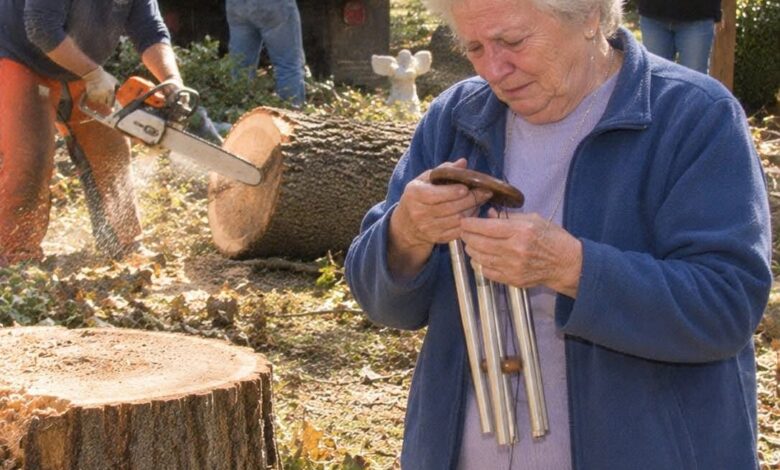
It was Tom’s handmade wind chime.
He had carved a small wooden bird for it during one of his final summers. It had never been a perfect piece of craftsmanship, but that was part of its charm.
After he passed away, I moved the wind chime from our back porch to the maple tree.
Every time a breeze passed through the yard, its gentle sound reminded me of him.
Now the strings were broken, and several metal tubes were bent.
I picked it up carefully.
Across the fence, my neighbor Pam was watching the workers.
She seemed pleased that the job was nearly finished.
When I asked what had happened, she explained that she had arranged for the tree to be removed because its leaves had been falling into her swimming pool.
I told her that the tree belonged to me and had been planted by my husband.
Her response made the moment even more painful.
She suggested that trees could be replaced, even if the people who planted them could not.
I looked down at the broken wind chime and realized that she had no idea what she had taken from our family.
Why My Husband Planted the Maple Tree
Tom was a high school shop teacher.
He believed that almost anything could be repaired with patience, care, and the right tools.
When our son Jeff was born, Tom left the hospital for a short time and returned home with a young sugar maple sapling.
He planted it in our front yard before coming back to meet me and our newborn son.
When I asked why he had chosen that particular day, he smiled.
He wanted our little boy to have a tree to climb.
And that was exactly what happened.
Jeff learned to climb its lower branches when he was small.
As he grew older, Tom helped him build a wooden treehouse among the branches.
There were childhood adventures, secret conversations, and countless afternoons filled with laughter.
Years later, our grandchildren discovered the same tree.
Tom repaired the treehouse so they could enjoy it safely.
Every autumn, the maple turned a brilliant shade of red.
Neighbors admired it, and people sometimes slowed their cars just to look at the leaves.
For us, it was never simply part of the landscaping.
It was a living reminder of the years we had shared.
The Final Promise Tom Left Behind
Tom passed away after a serious illness.
During his final months, he spent many afternoons looking through our bedroom window at the maple.
Even when he had little energy, he still asked whether it had been watered.
He loved that tree because it represented the life we had built together.
One of his last conversations with me was about the coming spring.
He reminded me that the maple would grow new buds when the weather became warmer.
After he was gone, I watched for those buds every morning.
When they finally appeared, I stood at the window and cried.
It felt as though something familiar had returned.
Later that spring, I hung his wind chime from one of the lower branches.
Its soft music became part of my daily routine.
I would hear it while washing dishes or preparing breakfast.
Sometimes I even spoke aloud to Tom, telling him about our grandchildren or the little repairs that needed attention around the house.
The tree made the silence of our home easier to bear.
That was why seeing it reduced to a stump felt like losing another piece of him.
The Disagreement With My Neighbor
Pam had moved next door several years earlier.
She replaced the older house on her property with a modern residence and a large backyard swimming pool.
At first, we were polite neighbors.
But the maple’s branches extended toward the fence, and during certain seasons, leaves would drift into her pool.
Pam complained about the extra cleaning.
I offered to rake more frequently and discuss reasonable maintenance options.
She wanted the tree removed.
Tom refused.
He believed there had to be a way to address the falling leaves without destroying a healthy tree that had stood for decades.
After Tom became ill, the disagreements continued.
Pam left increasingly impatient notes asking me to deal with the problem.
I was grieving, exhausted, and struggling to adjust to life without my husband.
I did not have the energy for another argument.
I never imagined that she would arrange for the entire tree to be cut down while I was away.
The Folder Hidden in Our Kitchen Drawer
After speaking with Pam, I went inside.
I placed the damaged wind chime on the kitchen counter and sat quietly for several minutes.
Then I remembered something.
During the last year of his life, Tom had spent an early morning looking through a folder in the kitchen drawer.
When I asked what he was doing, he mentioned paperwork concerning the tree.
At the time, I had not thought much about it.
Now I opened the drawer.
Among our household records, old photographs, and important documents, I found a thick folder with a municipal forestry emblem on its cover.
Inside was a certificate identifying our maple as a protected heritage tree under a fictional local tree-preservation program.
There were also copies of an old property survey and correspondence with the city’s forestry department.
According to the documents in the story, Tom had arranged for the maple to receive special recognition many years earlier.
He had wanted to protect it from unnecessary removal.
I turned another page and found a letter addressed to me.
It was written in Tom’s familiar handwriting.
A Letter That Changed Everything
Tom’s letter explained why he had applied for the tree designation.
Years earlier, there had been discussions about changes to our street that might have affected several mature trees.
He had researched ways to preserve the maple and submitted the necessary paperwork.
Eventually, the street project changed, but the tree’s protected status remained.
Tom admitted that he had forgotten to tell me about the designation.
Then he explained what I should do if anyone ever removed the tree without permission.
He advised me to stay calm, gather the documents, and contact the local forestry office.
He even included the name of the official who had originally helped him.
At the end of the letter, he reminded me how much he loved me.
I held the paper in my hands for a long time.
Even after his death, Tom had somehow left me one more practical solution to a problem.
It was exactly the sort of thing he would have done.
One Phone Call Brought an Unexpected Response
I contacted the forestry official named in the folder.
In this dramatized account, her name was Marisol Vega.
She remembered Tom and the maple tree.
When I explained that the tree had been removed, she asked whether any authorization had been obtained.
I did not know.
Marisol said she would look into the matter and advised me to preserve the documents and photographs.
Later that afternoon, she visited the property.
She examined the stump, reviewed the available records, and documented the condition of the yard.
She also spoke with the people involved in the removal.
The situation had become much more complicated than a disagreement over leaves.
The documents suggested that the tree had been protected under the town’s fictional heritage-tree program.
There were also questions about who had authorized the work and whether the tree crew had been given accurate information.
I did not feel happy about any of it.
I simply wanted someone to acknowledge that the tree had mattered.
The Consequences of a Decision Made Without Permission
In the weeks that followed, the local authorities reviewed what had happened.
The story’s fictional municipal rules provided for substantial penalties when a protected tree was removed without authorization.
The original assessment was described as $31,000, along with requirements for replacement planting.
That figure was part of the fictional storyline, not a verified fine imposed by a real Oregon municipality.
Pam was shocked.
She had believed that paying for the removal meant she could decide what happened to the tree.
But the situation raised important questions about property boundaries, consent, and responsibility.
The tree crew also acknowledged that additional verification should have taken place before work began.
For me, the most painful part was knowing that none of these discussions could bring back the original maple.
A financial penalty could not replace decades of family memories.
And no amount of paperwork could restore Tom’s wind chime to the branch where it had hung.
My Son’s Reaction to the Missing Tree
That evening, Jeff came to visit.
He stood in the front yard and stared at the stump.
For several minutes, neither of us spoke.
Then he knelt beside it.
He told me about the morning he left for college.
Before saying goodbye to us, he had climbed the maple one last time.
Near the top, he carved his initials and the year into a branch.
I had never known.
He was devastated to think that the carving was gone.
But something unexpected happened.
One of the workers had noticed the initials during the removal.
Realizing they might be meaningful to someone, he had saved a small piece of the branch.
When he later returned it to Jeff, my son held the wood as though it were a family photograph.
It was only a small fragment.
But it carried a memory that might otherwise have disappeared forever.
When Anger Began to Turn Into Understanding
As the dispute continued, some neighbors supported me.
Others believed the situation had gone too far.
A few thought the maple should have been trimmed years earlier.
I understood that people had different opinions about trees, property maintenance, and neighborhood responsibilities.
But I also knew that no one had asked my permission before removing something that belonged to me.
Still, as the weeks passed, I began to think about what I actually wanted.
Did I want Pam to suffer financially?
Did I want the entire neighborhood to remain divided?
Or did I want something meaningful to grow from what had happened?
I kept returning to Tom’s favorite saying.
He told his students to measure twice before cutting once.
He meant that people should understand what they were doing before taking an action they could not easily reverse.
Pam had made a decision without understanding its consequences.
I did not want to make the same mistake in my response.
A Surprising Request at the Hearing
When the dispute reached a fictional municipal hearing, I attended with Tom’s letter.
The officials reviewed the documents and discussed the proposed penalties.
Then I asked whether I could speak.
I explained that the maple had been planted when our son was born.
I described the treehouse, the grandchildren, and the wind chime.
I also explained that I did not want revenge.
I wanted the loss to be acknowledged.
And I wanted something positive to come from it.
Instead of asking for the harshest possible outcome, I requested that Pam help plant a replacement sugar maple.
I wanted her to place it in the same part of the yard and care for it during its early growth.
I also asked the officials to consider reducing the financial penalty if the applicable rules allowed it.
Everyone seemed surprised.
But to me, the request made sense.
A new tree could never replace the original.
It could, however, become the beginning of a different memory.
The Story Behind My Neighbor’s Anger
During the hearing, Pam finally explained why the falling leaves had bothered her so deeply.
Her frustration had not really been about cleaning the pool.
Several years earlier, her marriage had ended.
Her relationship with her adult daughter had also become distant.
Pam had moved to Oregon hoping to create a fresh start.
She built a beautiful house and a swimming pool because she imagined her daughter visiting someday.
But the visits never happened.
Every afternoon, Pam looked at her empty pool.
And beyond the fence, she saw my family gathering around the maple.
She saw grandchildren laughing, parents visiting, and a husband who had spent decades caring for the same home.
Those reminders made her feel increasingly isolated.
None of that excused her decision to remove my tree.
But it helped me understand why she had become so angry about something as ordinary as falling leaves.
Her perfect pool had become a symbol of the family life she missed.
And my maple had become a reminder of everything she believed she had lost.
Choosing Responsibility Instead of Revenge
I told Pam that I understood what it felt like to miss someone.
After Tom died, I continued setting out two coffee cups each morning.
It took months before I stopped reaching for his favorite mug.
I still occasionally expected to hear his footsteps in the hallway.
Grief had changed my daily routines in ways I could never have predicted.
Pam listened quietly.
For the first time, we were not arguing about property boundaries or swimming pools.
We were talking about loneliness.
I made it clear that what she had done was wrong.
But I also told her that I wanted to move forward.
In the fictional hearing, the officials approved a resolution involving a reduced penalty and replacement planting.
Pam agreed to participate personally.
The responsibility was no longer just about paying money.
It was about understanding the value of something she had destroyed.
Planting a New Maple Tree Together
A few weeks later, our family and several neighbors gathered in my front yard.
A young sugar maple had been selected for planting.
It was much smaller than Tom’s tree.
Its trunk was narrow, and its branches had only begun to develop.
But the leaves were already showing hints of autumn red.
Pam arrived wearing gardening gloves.
She admitted that she had never planted a tree before.
With guidance, she helped position the sapling, fill the hole with soil, and water it.
My grandchildren watched closely.
Jeff brought the small piece of wood bearing his initials.
We kept it as a family memento of the original tree.
My granddaughter made a painted sign for the new maple.
It read:
THIS IS GRANDPA’S TREE. IT GROWS BACK.
When the planting was finished, everyone stood quietly for a moment.
The yard looked different.
But it no longer looked empty.
The Wind Chime Returned
One of the workers who had helped remove the original maple offered to repair Tom’s wind chime.
He straightened the metal pieces, replaced damaged parts, and repaired the small wooden bird.
The chime was not exactly as it had been.
Some pieces were newer, and the repaired wood still showed a faint line.
But that did not bother me.
The repairs had become part of its history.
On the day we planted the new tree, I handed the wind chime to Pam.
I asked her to help hang it in a suitable place near the young maple.
She did so carefully.
A breeze moved through the yard.
The familiar sound returned.
For a moment, I closed my eyes.
It reminded me of Tom working outside on a summer afternoon.
And for the first time since the original tree was removed, I felt a little peace.
How an Unlikely Friendship Began
Pam continued helping care for the new maple.
Sometimes I joined her in the yard.
We talked about our families, our mistakes, and the things we wished we had handled differently.
Other evenings, we sat quietly and watched the leaves move.
Over time, our relationship changed.
We were not suddenly best friends.
There was still sadness surrounding what had happened.
But the anger gradually became easier to carry.
Pam also began rebuilding communication with her daughter.
Their relationship did not improve overnight.
There were difficult conversations and years of distance to address.
Eventually, her daughter came to visit.
They spent time together in the backyard, and the swimming pool finally became a place for shared memories rather than quiet disappointment.
I was glad to see it.
Not because everything had been forgotten, but because something good had grown from a painful experience.
A Family Tradition Continues
A couple of years later, our family welcomed another grandchild.
Jeff and his wife had a baby girl.
On the day she was born, Jeff went to a nursery and bought a young sugar maple.
He planted it in his own front yard.
When his wife asked why he had chosen that moment, he repeated the explanation Tom had given decades earlier.
He wanted their daughter to have a tree to climb.
When Jeff told me, I cried.
I realized that the most important part of Tom’s gift had never been the tree itself.
It was the love and care that inspired him to plant it.
That tradition had now passed to another generation.
What the Maple Tree Taught Me About Forgiveness
People sometimes ask whether I regret contacting the forestry office.
I do not.
The tree belonged to my family, and its removal deserved to be taken seriously.
But I am also grateful that the story did not end with punishment alone.
Pam learned to respect something she had not understood.
I learned that forgiveness does not require pretending that a harmful decision was acceptable.
And our neighbors learned that disagreements are easier to resolve when people listen before acting.
The original maple cannot return.
Its branches will never again hold the treehouse Tom built for Jeff.
But the new maple has become a symbol of another important lesson.
Some things cannot be repaired exactly as they were.
Sometimes we have to begin again.
Final Thoughts: The Memories We Leave Behind
Every autumn, the young maple turns red.
It is not yet as tall or as impressive as Tom’s original tree.
But it grows a little stronger each year.
The wind chime still hangs nearby, where I can hear it from the kitchen.
My grandchildren visit and ask about the old tree.
I tell them how their grandfather planted it when their father was born.
I tell them how much he loved working with his hands.
And I tell them why we planted another one.
The story is not simply about a neighbor cutting down a tree.
It is about the meaning we attach to ordinary places, the consequences of acting without understanding, and the possibility of rebuilding relationships after mistakes.
Tom always believed that careful work required patience.
I think he would have liked knowing that his final lesson was not about punishment.
It was about planting something worth caring for.
And every time the wind moves through the leaves, I remember that love can continue growing long after the people who first planted it are gone.


