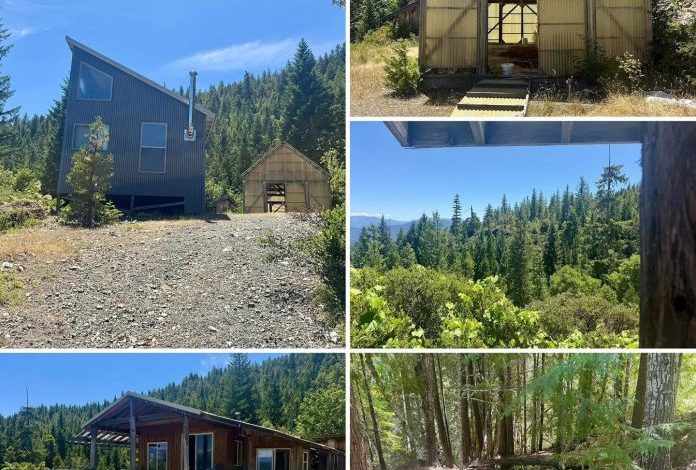
Remote 160-Acre California Mountain Property Offers Two Cabins, Greenhouse and Panoramic Views
Remote 160-Acre Mountain Property in Northern California Listed for $145,000
A remote mountain property in Northern California is being offered for $145,000, combining 160 acres of wooded terrain with a rustic cabin, an unfinished secondary cabin, a timber-frame greenhouse, and a reported year-round spring-water system. Located at 11000 Bluff Creek Road, also known as Bluff Creek Trail, near Orleans in Humboldt County, the property may appeal to buyers looking for a secluded retreat, recreational acreage, or an off-grid homestead.
According to the supplied listing information, the property was listed on June 27, 2026, under MLS number 272729. Its 160-acre footprint works out to approximately $906.25 per acre at the asking price. That calculation provides a simple way to compare the total acreage with other land listings, although it does not establish the property’s market value or account for the costs and limitations associated with remote mountain land.
A Large Parcel in a Remote Mountain Setting
The property is situated in the mountainous region surrounding Orleans, California, within Humboldt County. The setting is described as wooded, with ridge benches, sloping timberland, and natural drainage areas where springs emerge from the hillside. The listing also highlights views toward the Trinity Alps and Marble Mountain Wilderness.
For buyers who prioritize privacy and outdoor recreation, the scale of the parcel is one of its most notable features. A 160-acre property can offer considerable space for hiking, exploring, wildlife observation, and other rural activities, subject to property boundaries, applicable regulations, and access restrictions.
The land reportedly borders United States Forest Service (USFS) public land along its northern and western sides. This adjacency may be attractive to people who enjoy exploring public lands, but buyers should distinguish between owning private acreage and having permission to use surrounding public land in a particular way. Public-land access rules, road rights, and any applicable restrictions should be confirmed independently.
The property’s remote location is also an important consideration. Mountain roads, steep terrain, winter weather, and the distance to services can make everyday access more complicated than it would be for a conventional rural home. Prospective buyers should assess the route in person and determine what type of vehicle is needed throughout the year.
A 700-Square-Foot Cabin With Rustic Interior Features
The main structure is described as a 700-square-foot cabin with two bedrooms and one bathroom. According to the listing details, its interior includes cedar wall paneling, hand-debarked log accents, built-in cabinetry, and large windows intended to capture the surrounding mountain scenery.
An exterior wooden deck provides additional outdoor space and a vantage point over the surrounding landscape. For someone seeking a small mountain retreat, the combination of a compact cabin and extensive acreage may be more appealing than a larger residence on a smaller lot.
However, the stated bedroom and bathroom configuration should not automatically be taken as confirmation that the structure is approved for full-time residential use. Buyers should verify the building’s permit history, permitted occupancy, structural condition, water and sanitation arrangements, and any applicable county requirements.
The listing also does not, by itself, establish whether the cabin has a conventional electrical connection, a complete septic system, or all the facilities expected in a standard residence. Those details can materially affect both the property’s usability and the cost of maintaining it.
An Unfinished Guest Cabin Adds Potential
In addition to the main cabin, the property reportedly includes an unfinished guest cabin with a shed-style design. The described features include corrugated metal exterior siding, a standing-seam metal roof, insulation framing, large double-hung windows, a wood-burning stove, and a ladder-accessible sleeping loft.
The structure could offer additional space if it can be completed and used in compliance with local building requirements. Depending on its condition and permitted use, a finished secondary structure might serve as guest accommodation, a workshop, or another functional part of a rural property.
Before assigning a value to that potential, buyers should inspect the foundation, framing, roof, insulation, stove installation, and any existing electrical or plumbing work. They should also confirm whether permits were obtained and what approvals would be required to complete the interior.
An unfinished building can be useful, but the remaining work may involve more than flooring, drywall, and trim. Electrical systems, sanitation, fire safety, access, and code compliance can affect the overall budget. The actual cost will depend on the work already completed and the standards the buyer intends to meet.
Timber-Frame Greenhouse and Homestead Possibilities
A timber-frame greenhouse is another feature described in the listing. The structure reportedly uses translucent corrugated panels, creating a sheltered growing space that could be useful for cultivating vegetables and starting plants in a mountain environment.
For buyers interested in a small-scale homestead, a greenhouse can complement outdoor growing areas and provide a place to experiment with seasonal food production. Its usefulness will depend on factors such as sunlight exposure, temperature, ventilation, water availability, growing-season length, and the condition of the structure.
The presence of a greenhouse does not guarantee year-round food production or eliminate the need for outside supplies. At higher elevations, cold temperatures, snow, and changing seasonal conditions can affect both the growing season and maintenance requirements. Prospective owners should evaluate the site’s microclimate and determine whether the greenhouse is suitable for their intended crops.
Together, the main cabin, unfinished secondary structure, and greenhouse provide several existing improvements that distinguish the property from a completely undeveloped parcel. Their practical value, however, depends on their condition, legal status, and suitability for the buyer’s plans.
Reported Springs and Gravity-Fed Ponds
Water is another central feature of the listing. The property is described as having hillside springs that flow year-round and supply multiple ponds through a gravity-fed arrangement involving piping and water-catching infrastructure.
A spring-fed system can be valuable on a remote property where a municipal water connection may not be available. Gravity-fed delivery may also reduce the need for pumping in parts of the system, depending on the layout and elevation differences. The reported ponds could have additional recreational or agricultural uses, subject to local conditions and applicable rules.
Nevertheless, the phrase “year-round” should be verified rather than accepted as a guarantee of dependable water supply. Spring flow can vary with rainfall, drought, seasonal conditions, and other environmental factors. Buyers should inspect the source, piping, tanks, and ponds, measure flow during dry conditions where possible, and arrange appropriate water-quality testing before relying on the system for drinking or household use.
They should also investigate any relevant water rights, diversion rules, and restrictions. The existence of a spring does not automatically establish unrestricted rights to use or divert its water. Similarly, water suitable for irrigation is not necessarily safe for drinking without treatment.
A professional assessment of the water system can help establish whether it can support the intended occupancy and uses, as well as identify the cost of repairs, filtration, storage, or other improvements.
Off-Grid Living Requires a Practical Infrastructure Plan
The listing positions the property as a remote mountain holding with potential for off-grid use. For buyers considering that lifestyle, the first step is to establish exactly which systems are already operational and which remain incomplete.
Electricity is a particularly important question. Although a solar photovoltaic system and battery storage are suggested as possible improvements in the supplied planning estimates, the listing information does not clearly establish the condition of any existing power system. A buyer should confirm whether solar panels, batteries, generators, wiring, or other equipment are already present before estimating the cost of making the property functional.
The same approach applies to sanitation and heating. The main cabin’s bathroom configuration does not confirm the existence or approval of a functioning septic system. Buyers should verify the current sanitation arrangements and determine what installation or replacement work may be required. Any wood-burning stove should also be inspected for safe installation, proper venting, and compliance with applicable requirements.
Road access is equally important. The property is described as being reached by a dirt route involving Forest Service or private access roads off Bluff Creek Road. The legal status of that route, any recorded easements, maintenance obligations, seasonal restrictions, and vehicle requirements should be established before closing.
On remote land, a property that appears affordable at the asking price may still require substantial investment to support regular occupancy. Water, electricity, sanitation, access, fire safety, and communications should therefore be evaluated as part of the overall purchase decision.
Understanding the $145,000 Asking Price
At $145,000 for 160 acres, the asking price equates to approximately $906.25 per acre. This is a straightforward calculation based on the stated price and acreage, not an independent valuation of the property.
The supplied material also includes an illustrative allocation of the asking price among the wooded acreage, main cabin, unfinished guest cabin, spring system, ponds, and greenhouse. Such a breakdown can be useful as a way of thinking about the property’s different components, but the individual dollar amounts should not be treated as verified appraised values or confirmed replacement costs.
The value of remote timberland can vary significantly with legal access, terrain, timber characteristics, usable ground, water rights, wildfire exposure, permitted uses, and the availability of utilities. Structures may contribute value, but their condition and permit status can also create expenses or limitations.
The listing information references other acreage offerings in the Orleans area, including parcels described as having fewer acres or different improvements. Those figures may provide starting points for further research, but reliable comparisons require confirmation that the listings are current or accurately recorded, that the acreage and features are comparable, and that asking prices are not being confused with completed sale prices.
The supplied regional benchmark of $2,150 per acre also requires independent verification before it can be used to claim a specific discount or determine whether this property is priced below market. A lower price per acre does not necessarily mean a better purchase when access, terrain, development costs, and property restrictions differ.
The same caution applies to the effective figure of approximately $207.14 per square foot, calculated by dividing the full asking price by the 700-square-foot main cabin. Because the purchase includes 160 acres and additional structures, this figure should not be compared directly with the price per square foot of conventional homes.
Potential Improvement Costs
The supplied estimates suggest that buyers might budget approximately $22,000 to $53,000 for a range of possible improvements, including solar power and battery storage, completion of the guest cabin, road grading and drainage, water filtration and storage, and vegetation management around structures.
These figures are preliminary planning estimates, not contractor quotations or confirmed costs for this particular property. The final budget could be lower or substantially higher depending on the condition of the existing infrastructure, the distance equipment and materials must be transported, labor availability, permitting, and the difficulty of reaching individual work areas.
For example, a solar installation would need to be sized around actual electrical demand, winter sunlight, battery requirements, and backup arrangements. Completing the guest cabin would require a detailed inspection and confirmation of what work is permitted. Water treatment should be designed around test results rather than a generic equipment allowance.
Road and drainage work may also be more complex on mountain terrain than on a level residential lot. Before relying on the supplied budget, buyers should obtain site-specific assessments and written estimates from qualified professionals.
Wildfire preparation deserves particular attention. Vegetation management, defensible space, access for emergency vehicles, and the availability of water for fire protection can all affect the practical risks and ongoing costs of owning a wooded property in California.
Wildfire, Weather, and Long-Term Maintenance
A large mountain parcel can offer privacy and a strong connection to nature, but it also places greater responsibility on the owner. Wildfire exposure, fallen trees, erosion, damaged culverts, and the upkeep of private roads can create recurring expenses.
Buyers should review available wildfire-hazard information, inspect vegetation around the existing buildings, and understand the local requirements and recommendations for defensible space. They should also determine whether suitable insurance is available for the structures and intended use.
Winter weather is another consideration. The listing describes a high-elevation setting with four seasons and possible snowfall. Conditions can affect road access, delivery of supplies, water lines, and the ability to occupy the property comfortably. A site visit during favorable weather may not reveal all the limitations experienced during winter.
Remote ownership also requires planning for emergencies, maintenance visits, fuel and equipment storage, and communication where mobile service is unreliable. These are not necessarily reasons to reject the property, but they are important parts of assessing whether the location fits a buyer’s needs.
Who Might Consider This Property?
The acreage and existing structures may appeal to several types of buyers, although the suitability of the property depends on individual goals and the findings of due diligence.
Off-grid enthusiasts may be interested in the combination of a cabin, greenhouse, and reported spring system. Before committing, they would need to confirm that water, sanitation, electricity, access, and building approvals can support their intended level of self-sufficiency.
Hunters and outdoor recreation enthusiasts may value the extensive acreage and reported adjacency to public land. They should verify property boundaries, hunting regulations, legal access routes, and the rules governing activities on nearby USFS land.
Buyers seeking a private retreat may appreciate the mountain views and separation from more densely developed areas. However, those who need convenient access to shops, medical services, reliable broadband, or paved roads should carefully evaluate the distance and available infrastructure.
Land investors may also examine the parcel, but its potential return cannot be determined from the asking price and acreage alone. Timber value, development restrictions, holding costs, market liquidity, and eventual resale demand all require independent analysis. The listing does not establish a guaranteed return, future appreciation, or a specific resale value.
For buyers seeking a conventional move-in-ready home with standard utilities and straightforward financing, this property may require more work and uncertainty than a typical residential purchase.
Essential Due Diligence Before Making an Offer
Before proceeding, prospective buyers should verify the following items:
- Legal access: Confirm recorded ingress and egress rights, easements, road-maintenance responsibilities, and any permits or restrictions associated with Forest Service or private roads.
- Parcel boundaries: Obtain reliable parcel maps and consider a professional survey to establish property lines and confirm the reported boundaries with public land.
- Water system: Inspect the springs, pipes, tanks, and ponds; evaluate seasonal flow; test water quality; and verify applicable water rights and restrictions.
- Building and permit records: Confirm the legal status and permitted use of the main cabin, guest cabin, greenhouse, wood stove, and any existing electrical, plumbing, or sanitation systems.
- Septic and sanitation: Establish whether a functioning and approved system exists and determine what would be required for the intended occupancy.
- Power and communications: Confirm which electrical systems are operational, assess the feasibility of solar or backup power, and test available communication options.
- Wildfire and insurance: Review hazard information, defensible-space needs, emergency access, and insurance availability and costs.
- Taxes and ongoing expenses: Obtain current property-tax information and investigate road maintenance, equipment, water-system upkeep, and other recurring costs. The supplied annual tax estimate of approximately $1,600 to $1,800 should be confirmed with the relevant county records.
- Land-use restrictions: Consult Humboldt County and other relevant authorities regarding zoning, building permits, environmental restrictions, agricultural activities, and any intended future development.
- Professional cost estimates: Obtain site-specific assessments for the guest cabin, access road, solar power, water treatment, and other planned improvements before finalizing a total budget.
Final Thoughts
The property at 11000 Bluff Creek Road in Orleans, California, is listed at $145,000 and is described as including 160 acres of mountain land, a 700-square-foot two-bedroom cabin, an unfinished guest cabin, a timber-frame greenhouse, and a network of springs and ponds. Its reported boundaries with USFS public land and views toward the Trinity Alps and Marble Mountain Wilderness add to its appeal for buyers who prioritize space, privacy, and outdoor recreation.
At approximately $906.25 per acre, the asking price offers a useful starting point for comparing large rural parcels. However, the acreage alone does not determine whether the property represents good value. Legal access, water reliability, building approvals, wildfire exposure, infrastructure condition, and the cost of making the site suitable for the intended use may all affect the final decision.
For someone prepared to investigate the practical demands of remote mountain ownership, the property may be worth a closer look. The most important next step is to verify the listing details, inspect the land and structures, and establish the full cost of ownership before making a commitment.
This article is based on the property information supplied for the listing and is intended for informational purposes only. Prices, tax figures, property features, water availability, comparable listings, and improvement estimates should be independently verified. It is not an appraisal, legal opinion, engineering assessment, or guarantee of investment performance.