My Mother Disowned Me for Marrying a Single Mom – She Laughed at My Life, Then Broke Down When She Saw It Three Years Later!
She didn’t cry when the door slammed behind him, or when she lifted their wedding photograph from its silver frame and dropped it into the fire without hesitation. She simply turned toward me. I was five years old, already learning the value of silence, and she smiled in a way that felt less like comfort and more like instruction.
“Now it’s just us, Jonathan,” she said evenly. “And we don’t fall apart.”
That sentence became the foundation of our lives. My mother believed emotions were liabilities, softness a weakness that invited failure. Love, in her world, was not meant to soothe—it was meant to shape. She raised me with precision and discipline, as if reinforcing steel rather than nurturing a child. Piano lessons were mandatory. Posture was corrected without warning. Thank-you notes were rewritten until they were flawless. Excellence was expected. Contentment was irrelevant.
She did not want a happy son. She wanted an unbreakable one.
By the time I was twenty-seven, I understood that approval from her was a moving target I would never reach. Every success only raised her expectations. Still, one evening, I told her I was seeing someone.
We met at her favorite restaurant, the kind where the lighting is low, the napkins are folded into exact shapes, and silence feels expensive. She wore navy—her color for serious conversations—and ordered wine before I had even taken my seat.
“So,” she said calmly, “is this important, or are we just chatting?”
“I’m seeing someone,” I replied.
Her eyes sharpened with interest. “Tell me.”
“Her name is Anna. She’s a nurse. Works nights.”
That earned a faint nod of approval.
“Parents?”
“Both alive. Her mother is a teacher, her father’s a doctor. They live out of state.”
She smiled slightly, satisfied.
“She’s also a single mother,” I added. “Her son is seven.”
The pause was brief but unmistakable. She lifted her glass, took a measured sip, and recalculated.
“That’s a great deal of responsibility,” she said. “For someone with your potential.”
“She’s incredible,” I said quickly. “And her son—he’s amazing.”
“I’m sure she appreciates the support,” my mother replied coolly. “A good man is difficult to secure.”
She never said Anna’s name again.
Despite that, I introduced them weeks later.
We met at a small coffee shop near my apartment. Anna arrived late—the babysitter had canceled, so Aaron came with her. She looked tired but genuine, hair loosely tied back, jeans and a soft blouse instead of something carefully chosen. Aaron held her hand tightly, eyes scanning the room.
My mother shook Anna’s hand politely, her smile precise and distant.
“You must be exhausted,” she said.
“I am,” Anna replied with a small laugh.
My mother asked Aaron one question—his favorite subject. When he said art, she acknowledged it with a glance and then ignored him completely. She paid only for her own drink.
On the drive home, Anna wasn’t angry. Just honest.
“She doesn’t like me,” she said.
“She doesn’t know you,” I replied.
“She doesn’t want to,” Anna said quietly.
Two years later, I met my mother at an old piano showroom she loved. She used to bring me there as a child, claiming the acoustics made mistakes impossible to hide.
“So,” she said, fingers brushing the polished surface of a grand piano. “Is this relationship going anywhere?”
“I asked Anna to marry me.”
Her hand froze.
“I see.”
“She said yes.”
She straightened her blazer and avoided my eyes. “Then understand this. If you marry her, do not ever ask me for help. You are choosing that life.”
She didn’t argue. She didn’t cry.
She simply released me.
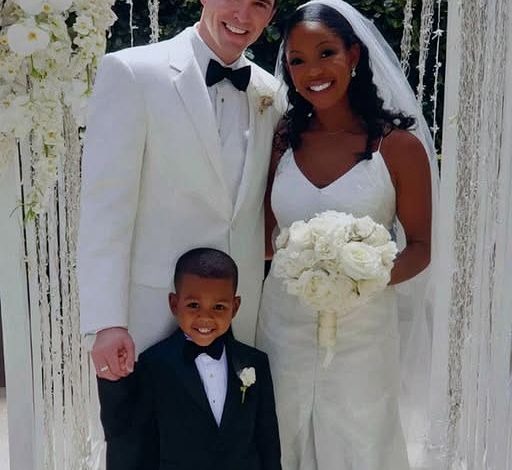
Anna and I married in a backyard strung with lights and laughter. No spectacle. Just warmth, honesty, and people who knew how to live without pretense. We moved into a small rental with stubborn drawers and a lemon tree in the yard. Aaron painted his room green and pressed his hands against the wall, leaving bright prints behind.
One night at the grocery store, he looked up at me and said, “Can we get the marshmallow cereal, Dad?”
He didn’t realize what he’d said. I did. I cried later, folding clean laundry, understanding that joy and grief can exist side by side.
We built a quiet life. Anna worked nights. I packed lunches, handled school pickups, learned how to reheat dinner without ruining it. We danced in socks, watched cartoons, collected mismatched mugs.
My mother never called.
Then, three years later, her name appeared on my phone.
“So this is really the life you chose,” she said.
“It is.”
“I’m back in town,” she continued. “I’ll stop by tomorrow. I’d like to see what you gave everything up for.”
Anna only smiled. “She’ll twist whatever she sees. Let her.”
I cleaned, but I didn’t hide anything.
The next afternoon, my mother arrived precisely on time, heels sharp against the floor, perfume filling the entryway. She walked inside without greeting me and stopped short.
“Oh my God,” she said. “What is this?”
She took in the secondhand furniture, the crayon marks, the worn floors. Her gaze lingered on Aaron’s green handprints near his bedroom door.
Then she heard the piano.
Aaron climbed onto the bench and began to play—slowly, carefully, but recognizably. Chopin. The same piece she had once forced me to practice until my hands hurt.
“Where did he learn that?” she asked quietly.
“He asked,” I said. “So I taught him.”
Aaron handed her a drawing. Our family on the porch. My mother stood in the upstairs window, surrounded by flowers.
“I didn’t know what kind you liked,” he said. “So I drew all of them.”
“We don’t yell here,” he added. “Daddy says yelling makes the house forget how to breathe.”
Later, my mother stared at her untouched tea.
“You could have been great,” she said. “You threw it away.”
“I am someone,” I replied. “I just stopped performing for the one person who never applauded.”
She looked at me then—not to judge, not to shape.
Anna spoke softly. “We’re not a punishment. And you don’t have to be the villain.”
My mother left without apology. No hug. Just a long look at Aaron as he spilled juice and wasn’t corrected.
That night, I found an envelope under the mat. Inside was a music store gift card and a note in her precise handwriting.
“For Aaron. Let him play because he wants to.”
I stood there for a long time.
It wasn’t forgiveness.
But for the first time, nothing felt broken.
And sometimes, that is enough to begin again.
Disclaimer: All stories published on this website are for entertainment and storytelling purposes only. They do not have an identified author and are not claimed to be based on real events or people. Any resemblance to actual persons or events is purely coincidental.