I Got My Dad All Wrong for Years — One Hospital Visit Turned Things Around
For much of my childhood, I resented my dad—even though he was the only parent I had. He raised me alone, working tirelessly, yet our life always felt like a struggle. We lived paycheck to paycheck, counting every dollar, and I grew up painfully aware of what we didn’t have compared to others. At school, I watched friends show off new gadgets, clothes, and vacations, while I pretended I didn’t care.
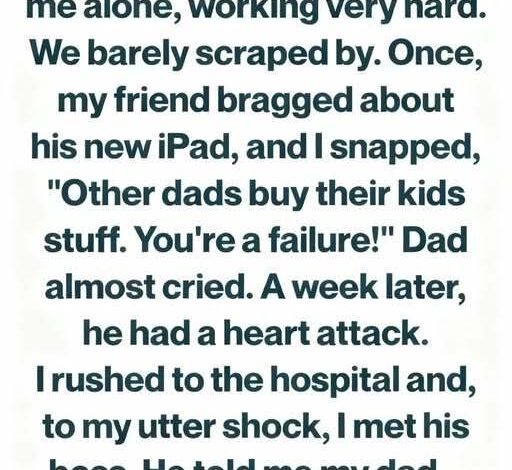
One day, when a friend proudly showed off his brand-new iPad, something inside me snapped. I went home furious and blamed my father for not giving me more. I’ll never forget the way his face fell, the hidden hurt he tried to mask. My pride kept me from apologizing.
A week later, everything changed. My dad had a heart attack. Sitting in the hospital, terrified and consumed with guilt, I replayed my harsh words over and over. While I waited, a man approached me—my father’s boss. At first, he didn’t know who I was, but when he realized, his expression softened. He told me things I had never known: how my dad was always the first to arrive and the last to leave, how he took the shifts no one else wanted, and how he turned down higher-paying jobs because they would have taken him away from me or required hours that left me alone. Listening, I felt a veil lift from my eyes.
When I finally sat beside my father’s hospital bed, I noticed details I had always overlooked: the deep lines on his face, the roughness of his hands, the exhaustion in his posture even as he slept. For the first time, I truly understood—his life hadn’t been small or unsuccessful. It had been defined by responsibility and sacrifice. He had chosen stability over comfort, presence over ambition.
When he woke, he tried to reassure me, saying everything would be fine. I couldn’t hold back. Through tears, I apologized, admitting how unfair I had been and how little I had understood. He didn’t blame me. He simply said he had always wanted me to have a better life, even if it meant he went without.
That moment changed everything—the way I saw him, and the way I measured success. Over time, he recovered, and so did our relationship. I learned that love doesn’t always show up in gifts or grand gestures. Sometimes it appears in long hours, quiet worry, and sacrifices no one notices.
Today, I’m grateful I had the chance to see the truth before it was too late. My father wasn’t a failure. He was a man who carried the weight of two roles without complaint. And the lesson he taught me, without ever intending to, is one I carry still: the greatest sacrifices are often the quietest.