
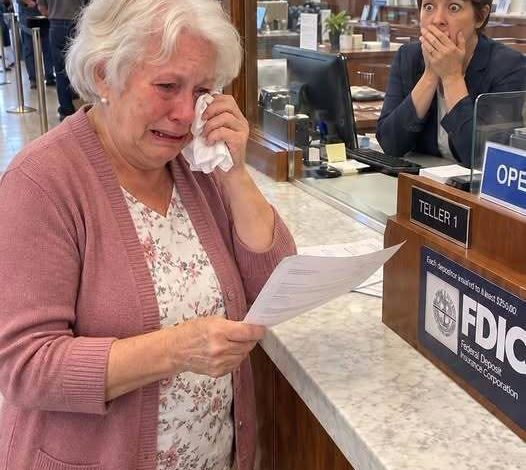
But I had never imagined seeing it again under circumstances like these.
“Please,” I whispered, looking at the manager. “Tell me what’s happening. Is there money in that account or not?”
The manager glanced toward the teller, then back at me.
“Mrs. Miller, I think you should sit down before you open this.”
That frightened me more than anything she could have said.
I was sixty-five years old. I had buried my parents, raised two children, survived a difficult marriage, and watched the man I loved walk away from me without looking back.
I thought I had already learned how much pain a human heart could carry.
Yet there I was, standing in a bank with an envelope in my hands, suddenly afraid of what a piece of paper might tell me.
A young employee guided me to a chair near the manager’s office. My handbag rested on my knees. My fingers were trembling so badly that I had to press them together to make them stop.
The manager sat opposite me.
“My name is Patricia,” she said gently. “I’ve reviewed the account associated with your card. There are some unusual instructions attached to it, and we need to verify your identity before I can explain everything.”
I nodded, though I barely understood what she was saying.
Then I tore open the envelope.
Inside was a folded letter, a small document bearing the bank’s stamp, and a second card that looked newer than the one I had carried in my handbag for five years.
I unfolded the letter.
The first line made my breath catch.
Dear Eleanor,
If you are reading this, it means you have finally decided to use the money I left for you.
I stopped.
I had expected a bank notice. Perhaps an explanation of an account that had been closed. Perhaps proof that Gregory had deceived me.
Instead, I was looking at a letter from the man who had broken my heart.
I continued reading.
I know you will probably hate me for what I did. I also know you may believe that three thousand dollars was all I thought thirty-seven years of marriage deserved.
You have every right to think that.
But the card I gave you that day was never the whole story.
My eyes blurred.
I lowered the letter and looked at Patricia.
“What does that mean?”
She folded her hands on the desk.“Mrs. Miller, the card you received was connected to an account that has remained active. The original balance was not the only money involved. Your former husband arranged for additional deposits to be made under specific instructions.”
I stared at her.
“Additional deposits?”
“Yes, ma’am.”
“How much?”
She paused.
Then she turned her computer screen slightly toward me.
I leaned forward.
For a moment, the numbers meant nothing. My mind refused to understand them.
Then I read them again.
$187,642.38.
I gripped the edge of the desk.
“No.”
The word came out as a whisper.
Patricia waited.
“No,” I repeated, shaking my head. “That can’t be right. The card was supposed to have three thousand dollars on it. He told me that himself.”
“The original deposit was three thousand dollars,” she explained. “But your former husband established a separate arrangement. The funds were deposited over time, and the account earned interest.”
I looked at the number again.
Nearly one hundred and eighty-eight thousand dollars.
For five years, I had cleaned other people’s kitchens until my fingers cracked in winter. I had skipped meals. I had worn the same shoes until the soles separated. I had counted coins at my kitchen table and wondered whether I could afford to fill my prescription.
And all that time, money had been accumulating in an account bearing my name.
My name.
Not Gregory’s.
Mine.
A terrible thought suddenly rose in my mind.
“Did he know I was struggling?”
Patricia did not answer immediately.
That silence was enough to make my stomach tighten.
I looked down at the letter again.
Eleanor,
There is something I should have told you long before our marriage ended.
The first time I realized I might lose everything, I didn’t tell you. I told myself I was protecting you. In truth, I was protecting my pride.
I read the paragraph twice.
Then I turned the page.
Twenty-three years ago, the business was close to collapsing. I had borrowed money to keep it alive, and I had made decisions I was too ashamed to discuss with you. I thought I could repair everything before you ever found out.
You remember the nights I came home late. You remember the calls I took outside. You remember how I became a stranger in my own house.
You asked me what was wrong.
I told you nothing.
My hands began to shake again.
I remembered those years.
Gregory had owned a small commercial construction company. It had never made us wealthy, but it had paid the mortgage and kept food on the table. When our children were young, I had helped with invoices and bookkeeping while also working part-time at a grocery store.
Then the company began to struggle.
Gregory became irritable. He stopped talking about work. He spent more time away from home and grew angry whenever I asked questions.
I had believed there was another woman.
Perhaps there had been. I still did not know everything about the final years of our marriage.
But the letter was revealing something else.
Something I had never known.
I made mistakes that cost us years of peace. I borrowed against the house without explaining how frightened I was. When things finally began to improve, I had become so accustomed to hiding the truth that I didn’t know how to tell you.
You stood beside me through the worst of it. You sold your jewelry when we needed money. You took extra shifts. You never once made me feel like a failure.
And I repaid you by shutting you out.
I pressed the letter against my chest.
For a moment, I could almost see my younger self standing in our old kitchen, wearing an apron and waiting for Gregory to come home.
I remembered making his favorite dinner on the nights I thought he looked especially tired.
I remembered telling our children that their father was simply under pressure.
I remembered lying awake beside him, listening to his breathing, wondering what I had done wrong.
I had spent years believing that I had somehow become insufficient.
Not pretty enough.
Not interesting enough.
Not worth the effort of an honest conversation.
Now, sitting in a bank office, I was learning that the story of our marriage had contained secrets I had never been allowed to see.
But the money still made no sense.
I turned to Patricia.
“Why did he give me a card with only three thousand dollars on it? Why not tell me about this account?”
Patricia looked at the second card.
“There’s another part of the arrangement, Mrs. Miller. Your former husband left instructions that we could provide the full explanation only after you presented the original card and completed the verification process.”
“Why?”
“I believe he wanted you to make the decision to come here yourself.”
I frowned.
“What decision?”
Patricia took a breath.
“Whether to leave the money untouched or claim it.”
I felt anger rise through my confusion.
“He made me suffer for five years just to see whether I would come to a bank?”
“No,” she said quickly. “I don’t believe that was the purpose.”
“Then what was it?”
She lowered her eyes for a moment.
“I think the letter will explain more.”
I returned to the page.
The next paragraph was shorter.
I knew your pride would make you refuse help from me. I knew that if I placed a large sum in front of you, you would think I was trying to buy your silence or purchase your forgiveness.
So I gave you the smallest amount I could justify giving you without making another promise I wasn’t certain I could keep.
I was wrong to do it that way.
I should have told you the truth. I should have given you the choice.
I stopped reading.
For the first time that morning, I felt something other than fear.
I felt furious.
“You don’t get to decide what I can bear,” I whispered.
Patricia remained quiet.
I read the next lines.
The money in the account came from the sale of my share in the company, the investments I made afterward, and payments I arranged over the years. It belongs to you. I have signed the documents necessary to make that clear.
It is not payment for our marriage.
It is not payment for your forgiveness.
And it is not an apology large enough to erase what I did.
It is simply money that should never have been hidden from you.
I lowered the paper.
For five years, I had refused to spend three thousand dollars because I believed it represented the price Gregory had placed on my life.
Now I was being told that the money had been only a fraction of what he had arranged for me.
I should have felt relieved.
Instead, I felt grief so deep that it seemed to open a hollow place beneath my ribs.
Because if Gregory had been able to help me, why had I spent five winters wondering whether I could afford the heating bill?
Why had I stood in the pharmacy, holding a prescription I couldn’t pay for?
Why had I told my daughter that I had eaten dinner when I had only had tea?
Why had I believed I was alone?
I looked at Patricia.
“Did he know about my illness?”
Her expression changed.
“What illness, Mrs. Miller?”
I told her about the clinic. About the tests. About the doctor who had warned me that I could no longer postpone treatment.
When I finished, Patricia reached for the document that had been inside the envelope.
“I can’t answer that question yet,” she said. “But there’s a final instruction here that you should see.”
She placed the document in front of me.
It was dated five years earlier, the same week my divorce had become final.
At the bottom was Gregory’s signature.
Above it, one sentence had been underlined.
If Eleanor ever needs medical care, please make sure she knows that the money is available to her without delay.
My throat tightened.
I read the sentence again.
Then I noticed something written beneath it in smaller handwriting.
If she comes to the bank herself, give her the second envelope.
I looked up.
“The second envelope?”
Patricia nodded.
“There was another envelope in the file. We were instructed not to release it until you had accessed the account.”
She stood, walked to a locked cabinet, and returned with a cream-colored envelope.
This one was thinner.
My full name was written across it in the same familiar handwriting.
But beneath my name were four words that made my blood run cold.
Please tell her the truth.
I held the envelope without opening it.
“What truth?” I whispered.
Patricia looked at me with an expression I would never forget.
“Mrs. Miller, I think this letter may explain why your former husband made these arrangements. But there’s one thing you should understand before you read it.”
“What?”
“Your former husband did not come to the bank alone when he arranged the account.”
I stared at her.
“Who came with him?”
Patricia slid the envelope closer.
“Your daughter, Susan.”
And suddenly, the room felt much smaller.
Because Susan had been the one who called me every Sunday.
Susan had been the one who asked whether I was eating properly.
Susan had been the one who told me, more than once, that Gregory was a man who had never understood how to love anyone properly.
And now I was being told that she had known something about this money.
Something she had kept from me for five years.
I opened the second envelope.
Inside was a single sheet of paper.
The first sentence read:
Mom, if you are reading this, it means Dad kept his promise to me, even if he failed to keep his promises to you.
I stopped breathing.
Then I read the next line.
There is something about the day he left you that neither of us has ever had the courage to explain.
PART 3: The Secret My Daughter Had Kept for Five Years
I could not continue reading.
My daughter.
My own Susan.
The little girl who used to climb into my bed during thunderstorms. The teenager who cried against my shoulder after her first heartbreak. The woman who held my hand when I signed the divorce papers and whispered, “You deserve better, Mom.”
She had been there when Gregory walked away.
She had watched me struggle.
And apparently, she had known something I did not.
I placed the letter on the desk.
“Call her.”
Patricia looked uncertain.
“Do you want to finish reading first?”
“No.” My voice surprised even me. “I want to hear it from her.”
My fingers trembled as I took my phone from my handbag.
Susan answered on the fourth ring.
“Mom? Are you all right?”
I closed my eyes.
It was such an ordinary question.
The same question she had asked me hundreds of times over the past five years.
Usually, I would have answered the way I always did.
“I’m fine, sweetheart. Don’t worry about me.”
But I was tired of pretending.
“Susan, I’m at the bank.”
Silence.
Not the brief silence of someone trying to understand.
A different silence.
A silence that seemed to stretch across the five years between us.
Then she whispered, “You opened it.”
I gripped the phone.
“You knew?”
A shaky breath came through the speaker.
“Mom, please.”
“Did you know there was money in that account?”
“Yes.”
The word was so quiet that I almost missed it.
I stared at the wall.
“How long?”
“Since the day Dad arranged it.”
I felt as though someone had struck me.
“You knew for five years?”
“Yes.”
“And you let me struggle?”
“No, Mom. Please, let me explain.”
“Explain what, Susan? Explain why I was counting coins to buy groceries while you knew there was money sitting in a bank account with my name on it?”
She began to cry.
I had heard my daughter cry many times.
As a child, she cried when she scraped her knees. As a teenager, she cried when her grandmother died. As an adult, she cried when her marriage nearly ended.
I had always wanted to comfort her.
But that morning, I could not find the strength.
“Come to the bank,” I said.
“I will.”
“Now.”
“I’ll be there as soon as I can.”
I ended the call.
For the next forty minutes, I sat beside Patricia with Gregory’s two letters in front of me.
I read Susan’s letter again, slowly this time.
Mom,
Dad came to see me three days before the divorce was finalized. He told me he had made a terrible mistake and that he wanted to leave you with something more than the house and the money you were legally entitled to receive.
I was furious with him. I told him that after everything he had done, he didn’t get to decide what would make things right.
He said he understood.
Then he told me something I had never heard before.
He said that when the business was failing, you had secretly taken money from your retirement savings to help keep it alive.
You never told me. You never told anyone.
He said he had only learned the full amount after he found your old financial records while preparing the divorce paperwork.
My eyes filled with tears.
I remembered that money.
Years earlier, when Gregory’s company had been close to collapse, I had withdrawn most of the savings I had set aside for retirement.
I had done it because I believed we were building a life together.
I believed that if I helped him through the worst months, things would eventually improve.
Gregory had promised to replace every dollar.
He never did.
Eventually, I stopped asking.
I had told myself that a marriage was not a ledger. That love meant helping each other when the world became difficult.
I had never imagined he would remember the amount years later.
Susan’s letter continued.
Dad said he could never repay what you gave him in the years when you were still together. He said that by the time he understood how much you had sacrificed, he had already become too ashamed to speak honestly with you.
I asked him why he didn’t tell you about the account.
He said you would refuse it if you believed it came from pity.
I told him that you had a right to know the truth, and he agreed. But he asked me not to interfere with the arrangement unless you came to the bank yourself.
I argued with him. I told him that you might need the money long before you decided to use the card.
He said he knew.
Then he said something I have never forgotten.
He told me that he could not force you to accept anything from him. He could only make sure that, if you ever chose to accept it, it would be there.
I lowered the letter.
I understood part of it now.
Gregory had known my pride.
He had known that I would rather struggle than accept a gift from the man who had left me.
But understanding his reasoning did not erase the consequences.
He had protected my right to refuse the money while leaving me unaware that I had anything to refuse.
That was not the same as giving me a choice.
The door to the bank office opened.
Susan stood there, breathing hard, her coat unbuttoned and her hair coming loose from its clip.
She looked at me.
Then she looked at the letters.
And she began to cry again.
“Mom.”
I stood up.
“Tell me everything.”
She nodded.
Then, instead of sitting down, she walked toward me and reached for my hands.
I did not pull away.
But I did not hold hers, either.
She swallowed.
“Dad didn’t leave you because he had stopped caring about you.”
I stared at her.
“Then why did he leave?”
She took a long breath.
“Because he was afraid you would spend the rest of your life paying for his mistakes.”
I shook my head.
“That doesn’t make sense.”
“I know.”
She sat down.
“After the company recovered, Dad became obsessed with making enough money to replace everything he had taken from the family. He worked constantly. He stopped coming home early. He stopped telling you what he was doing. He believed that if he could make enough money, he could somehow undo the years when you had to worry about bills.”
I remembered Gregory sitting at the kitchen table with his accounts spread in front of him.
I remembered asking him to take a weekend off.
I remembered him saying, “Not yet, Eleanor. Just a little longer.”
At the time, I had believed he was simply choosing work over me.
Perhaps, in some ways, he had.
Susan continued.
“But the more he tried to repair things with money, the less he knew how to repair things with words. He felt guilty every time he looked at you. And instead of admitting that guilt, he became distant and cruel.”
I looked away.
“That is not an excuse.”
“No,” she said immediately. “It isn’t.”
Her agreement surprised me.
She wiped her eyes.
“I told him that, too. I told him he had spent years hurting you and that he couldn’t call it love just because he felt guilty afterward.”
For the first time that morning, I saw my daughter not as the little girl who had kept a secret from me, but as a woman who had been caught between two people she loved.
It did not excuse her silence.
But it helped me understand its weight.
“Why didn’t you tell me about the money?” I asked.
Susan looked down at her hands.
“Because I was afraid.”
“Of what?”
“That you would refuse it. That you would tear up the papers and never touch the account. That you would feel as though Dad was trying to buy his way back into your life.”
I felt tears sliding down my cheeks.
“So you decided to keep me in the dark.”
“Yes.”
She did not defend herself.
“I told myself I was respecting your independence. I told myself you would come to the bank if you ever really needed the money. But those were excuses. I was afraid of making the wrong decision, so I let you make it without all the information.”
She reached into her handbag and took out a folded sheet of paper.
“There is something else.”
I did not take it.
“What now?”
“This is a letter Dad gave me on the day of the divorce. He told me to keep it until you found out about the account.”
I looked at her.
“Another letter?”
She nodded.
I almost laughed, though there was nothing funny about it.
“Your father has managed to speak more to me from a distance than he ever did when we were married.”
Susan placed the letter on the table.
I unfolded it.
Eleanor,
There is no good way to explain the things I did.
I could tell you that I was frightened. I could tell you that I felt ashamed. I could tell you that I spent years trying to repair the damage I had caused and failed to understand that you were waiting for me to simply tell you the truth.
All of those things would be true.
None of them would make the years you lost any less real.
I paused.
The words were painfully simple.
There were no grand declarations. No promises that he had always been the perfect husband. No attempt to convince me that our divorce had been inevitable.
For once, Gregory was not trying to make himself look better.
I continued.
When we married, I promised to stand beside you. You did that for me, even when I gave you reasons not to.
When I became frightened of losing everything, I treated you as though you were one more problem I had to solve alone.
When I became ashamed of my failures, I made you feel as though you were the failure.
I am sorry for that.
I cannot ask you to forgive me. I cannot ask you to remember our marriage differently. And I will not tell you that the good years should outweigh the bad ones.
You lived every one of those years. You have the right to remember them exactly as they were.
I pressed my lips together.
For years, I had wanted Gregory to admit that I had not imagined the distance between us.
I had wanted him to acknowledge that I had tried.
That I had asked questions.
That I had waited.
That I had loved him even when I no longer understood the man beside me.
Now, five years too late, he was finally acknowledging it.
And I hated how much those words mattered to me.
The letter continued.
There is one more thing I need you to know.
The money in the account is yours, without conditions. You do not owe me a visit, a phone call, a reply, or forgiveness.
If you use it for medical care, I hope it gives you more time and less fear.
If you use it to move somewhere warmer, I hope you find a home where you can sleep peacefully.
If you spend it on something you have always wanted but never thought you could afford, I hope you do so without feeling guilty.
And if you decide never to touch it, I will respect that, too.
I spent too many years believing that providing for someone was the same as loving them.
I know now that love without honesty can become another kind of loneliness.
I am sorry I learned that too late.
At the bottom of the page, Gregory had written one final sentence.
You were never worth only three thousand dollars, Eleanor. You were worth the truth.
I began to cry.
Not quietly.
Not gracefully.
I cried with my whole body, the way I had wanted to cry on the courthouse steps five years earlier but had refused to let myself.
Susan stood and wrapped her arms around me.
This time, I held on to her.
We remained that way for a long time.
Eventually, I stepped back and wiped my face.
“I am angry with you,” I told her.
“I know.”
“I don’t know how long it will take me to stop being angry.”
“I understand.”
“And I don’t want you to tell me you did it for my own good.”
She nodded.
“I won’t.”
I looked at the letters spread across the desk.
“Your father should have told me himself.”
“Yes.”
“He should have trusted me to make my own decisions.”
“Yes.”
“And I should never have had to reach a bank office at sixty-five years old, terrified about how I was going to pay for medical treatment, before I learned that I had money available to me.”
Susan’s eyes filled again.
“No, Mom. You shouldn’t have.”
For the first time in five years, I felt that someone was finally listening without trying to explain away my pain.
It did not repair everything.
But it was a beginning.
Then Patricia gently cleared her throat.
“I’m sorry to interrupt,” she said. “There is one final matter we need to discuss before we can complete the account transfer.”
I turned toward her.
“What else is there?”
She opened the document folder again.
“The account balance is available to you, subject to the bank’s verification process. However, your former husband’s instructions also mention a personal document that he deposited with us.”
I looked at Susan.
She seemed just as surprised as I was.
“What kind of document?” I asked.
Patricia removed a thin, folded paper.
“It appears to be a copy of a deed.”
She laid it in front of me.
At the top was the address of a small house in northern Minnesota.
I recognized it immediately.
It was the house where Gregory had grown up.
A modest wooden home near a lake, with a sagging porch and a maple tree in the front yard. His mother had lived there until her death. Years ago, before our marriage fell apart, Gregory had told me he hoped to repair it one day.
I had forgotten about that dream.
Or perhaps I had simply buried it beneath everything that came afterward.
“Why would he leave this here?” I asked.
Patricia turned the page.
The document showed that the property had been transferred into a trust, with instructions concerning its eventual ownership.
My name appeared on the page.
So did Susan’s.
But there was another detail.
The transfer had been arranged only months before Gregory’s death.
I stared at the date.
“Gregory is dead?”
Susan looked at me sharply.
“Mom, didn’t you know?”
My mouth went dry.
“No.”
She covered her face with both hands.
“Dad died last winter.”
For a moment, I could not hear anything else in the room.
Gregory was dead.
The man I had spent five years trying not to think about. The man whose card I had hidden in a box. The man I had blamed for every cold morning and every lonely night.
He had been gone for months.
And I had not known.
I gripped the edge of the table.
“How?”
Susan sat beside me.
“He had a heart attack. He was at home. His neighbor found him.”
I stared at the deed.
“Why didn’t you tell me?”
Susan’s answer came through tears.
“Because you told me, after the divorce, that you never wanted to hear about him again. When he died, I thought telling you would only hurt you.”
I closed my eyes.
Once again, someone had decided that protecting me meant withholding the truth.
Once again, I had been denied the chance to decide for myself what I wanted to know.
I sat very still.
I did not suddenly feel that I loved Gregory again.
I did not forget the years of loneliness, the unanswered questions, or the humiliation of accepting the smallest gift from a man who had shared my life for nearly four decades.
But I felt the strange ache of knowing that a conversation I had never received was now impossible.
There would be no chance to ask why he had waited so long.
No chance to ask what he had truly felt during the final years of our marriage.
No chance to tell him that his apology had arrived too late to undo the hurt, but not too late to matter.
And no chance to ask whether he had ever stood somewhere, alone, wishing he could go back and do things differently.
I folded the letter carefully.
Then I looked at Patricia.
“What do I need to do?”
She explained the remaining paperwork. I would need to complete the verification process, review the account documents, and consult an appropriate professional about the property transfer and any legal or tax questions. Nothing would be handed over without the necessary checks.
For the first time that day, I listened carefully.
I asked questions.
I wrote down the answers.
I refused to sign anything until I understood it.
I had spent too much of my life letting other people decide what I could bear.
I would not do that again.
When Susan and I finally left the bank, the afternoon sun had broken through the clouds.
The streets were busy. Cars moved through the intersection. People hurried past carrying coffee cups and shopping bags, each of them absorbed in a life I knew nothing about.
I stood on the sidewalk and looked down at the old card in my hand.
For five years, I had believed it represented the last insult of my marriage.
Now I understood that it represented something more complicated.
It carried Gregory’s guilt, his fear, his attempt at making amends, and his failure to understand that secrecy can wound even when it is intended as protection.
It also carried the consequences of my own pride.
I had refused to use the money because I could not bear to accept anything from him.
I had believed that refusing it was the only way to preserve my dignity.
But dignity should never have required me to go hungry.
It should never have required me to ignore a doctor’s warning.
And it should never have required me to prove that I could survive without help.
I looked at Susan.
“Take me to the clinic tomorrow,” I said.
She nodded immediately.
“I will.”
“And today, we’re going to find out exactly what my treatment will cost.”
“All right, Mom.”
“Then we’re going to get something to eat.”
She gave a small, tearful laugh.
“Anything you want.”
I looked at her.
“Don’t say that unless you mean it.”
“I mean it.”
For the first time in a long while, I believed her.
We walked to a small café around the corner and sat beside a window. I ordered soup, bread, and a cup of tea.
Nothing extravagant.
Nothing that would have impressed anyone.
But when the bowl arrived, I ate every spoonful without calculating how much food I would have left for tomorrow.
That evening, I returned to my little room and opened the old box where I had kept the card.
I took out the photographs I had stored there, too.
There was one of Gregory and me on our wedding day. We looked impossibly young. His hair was thick and dark, and my smile seemed to belong to a woman who had never imagined how difficult life could become.
I studied the photograph for a long time.
I did not tear it up.
I did not kiss it.
I simply placed it beside his letter.
Then I opened my notebook and wrote down three things I needed to do.
Call the clinic.
Meet with a financial adviser.
Find out what the house in Minnesota was worth and what the trust documents actually required.
At the bottom of the page, I wrote one more sentence.
Stop apologizing for needing help.
I read it twice.
Then I underlined it.
The next morning, Susan came to take me to my appointment.
We sat together in the waiting room while other patients spoke quietly and nurses moved through the corridors. When the doctor called my name, Susan rose with me.
I paused at the door.
“I can go in alone,” I told her.
She nodded, though I could see the worry in her eyes.
“Of course, Mom.”
I looked at her for a moment.
“Would you like to come in with me?”
Her face softened.
“Yes.”
So we went in together.
The doctor reviewed my results and explained the treatment options. There were risks, costs, and difficult decisions ahead. The money in the bank would not magically make me young again, nor could it guarantee that everything would be all right.
But for the first time, I could consider treatment without wondering whether it would leave me unable to pay the rent.
For the first time, I could ask what gave me the best chance rather than simply asking what I could afford.
That difference changed everything.
Over the following weeks, I began putting my life back in order.
I paid the bills I had postponed. I bought groceries without standing in the aisle adding every price in my head. I replaced my worn-out shoes. I made an appointment with a financial adviser and learned how to protect the money Gregory had left.
I did not rush into buying a new home or making extravagant plans.
I had learned too much about uncertainty to mistake money for a guarantee.
But I allowed myself small pleasures.
Fresh flowers on the kitchen table.
A warm coat that actually fit.
A book I had wanted to read for years.
And one Sunday afternoon, I took a bus to a nearby park, sat on a bench, and watched children chase one another across the grass.
For the first time in five years, I was not calculating the cost of being alive.
I was simply alive.
Susan and I did not repair our relationship overnight.
Some days, I was angry with her. Some days, she struggled to explain why she had remained silent. We had conversations that ended in tears, and others that ended with a quiet cup of tea.
I told her that love did not give her permission to make decisions on my behalf.
She told me she understood.
Slowly, we began to trust one another again.
As for Gregory, I never found a single answer that explained everything he had done.
Perhaps he had genuinely wanted to protect me.
Perhaps he had also wanted to escape the shame of facing me.
Perhaps both things were true.
People are rarely as simple as the stories we tell ourselves about them.
He had hurt me.
He had also helped me, though in a way that had left me struggling unnecessarily.
His final letters did not erase our marriage’s failures.
But they gave me something I had not possessed for years: the knowledge that my sacrifices had not gone entirely unseen.
One month later, I returned to the bank to finish the remaining paperwork.
This time, I wore my new coat and carried a folder with all my documents neatly arranged.
Patricia recognized me and smiled.
“How are you doing, Mrs. Miller?”
I thought about the question.
For years, I would have smiled automatically and said I was managing.
This time, I answered honestly.
“I’m getting better.”
She nodded.
“I’m glad to hear that.”
Before leaving, I asked her to make one copy of Gregory’s final letter for me.
I wanted to keep the original somewhere safe.
The copy went into my handbag.
Not because I needed to read his apology every day.
Not because I had decided he deserved forgiveness.
But because I wanted to remember the lesson I had learned at sixty-five.
Never let someone else’s silence convince you that your life has no value.
Never confuse refusing help with being strong.
And never allow pride to become another locked door between you and the life you still have a chance to live.
That evening, I placed Gregory’s letter in a drawer beside my wedding photograph.
I left the drawer unlocked.
Then I made myself a cup of tea and sat beside the window.
Outside, the sky was turning pink.
I thought about the woman I had been five years earlier, standing in a courthouse hallway, watching her husband disappear around a corner.
I wished I could reach back through time and tell her something.
I would tell her that she was going to survive.
That she would have difficult mornings and lonely nights, but they would not last forever.
That she would one day sit in a bank office and discover that the story she had believed about her life was not the whole story.
And I would tell her that she did not have to wait for Gregory’s money, his apology, or his death to begin living again.
Because the greatest thing I recovered that day was not the money.
It was my right to choose what happened next.
I could seek treatment.
I could make a new home.
I could spend time with my children without pretending that everything was fine.
I could remember the good years of my marriage without excusing the bad ones.
And I could leave the rest behind.
At sixty-five, I had imagined that my life had already been written.
Thirty-seven years of marriage.
Five years of loneliness.
One bank card I could not bear to use.
But life, I discovered, does not always end when a chapter closes.
Sometimes, a new chapter begins with trembling hands, an unopened envelope, and the courage to finally ask the questions you should never have been afraid to ask.
I took one last sip of tea and looked out at the fading light.
For the first time in five years, I did not feel as though I were waiting for someone to come back and explain my life to me.
Gregory was gone.
The past could not be changed.
But tomorrow was still mine.
And that, I realized, was worth far more than any amount of money in a bank.
The End.


