1890 Farmhouse on 40.09 Acres in Virginia Listed for $100,000
$100,000 Virginia Property Offers 40 Acres, an 1890 Farmhouse, and Historic Farm Buildings
What can $100,000 buy in rural Virginia? In Buchanan County, a property on Hobbs Branch Road near Grundy offers approximately 40 acres, an old farmhouse, a traditional barn, and several additional agricultural structures. For buyers searching for rural land, historic homes, or potential homestead properties, the listing presents an opportunity worth examining. However, the condition of the existing buildings makes this a very different proposition from purchasing a home that is ready for immediate occupancy.
Listed for $100,000, the property reportedly includes 40.09 acres and a two-story farmhouse dating to approximately 1890. The house is described as having three bedrooms and one bathroom, with an estimated living area of 2,000 square feet. A barn, former dairy building, and another outbuilding add to the property’s historic agricultural character.
The listing also describes a mix of relatively level bottomland, rolling terrain, and wooded areas. These features may appeal to buyers interested in gardening, rural recreation, or establishing a small homestead.
However, the farmhouse has reportedly been unoccupied for many years, and its interior and exterior conditions are rated poor. Photographs show visible deterioration, boarded windows, damaged interior finishes, and aging outbuildings. Utility information is also limited, leaving important questions about the cost of restoring the property.
For prospective buyers, the central question is whether the land and existing structures justify the purchase price once inspection findings, infrastructure requirements, and renovation expenses are considered.
Property Overview
- Asking price: $100,000
- Location: Hobbs Branch Road, Grundy, Virginia 24614
- County: Buchanan County, Virginia
- Land area: Approximately 40.09 acres
- Property type: Single-family residence with agricultural outbuildings
- Bedrooms: 3
- Bathrooms: 1
- Reported living area: Approximately 2,000 square feet
- Estimated year built: 1890
- Stories: 2
- Foundation: Stone, according to the listing
- Roof: Metal, according to the listing
- Heating and cooling: None reported
- Water and sewer: Listed as “Other”; systems not specified
- Additional structures: Barn, former dairy building, and another outbuilding
- HOA: None reported
- Annual property taxes: Approximately $200, according to the listing
- Road surface: Unimproved, according to the supplied information
The listing identifies the farmhouse’s age and square footage as estimates. Buyers should verify these details and confirm the current listing status, property boundaries, utility arrangements, and building conditions before making a purchase decision.
What Makes This 40-Acre Virginia Property Interesting?
The main attraction is the combination of acreage and existing farm infrastructure.
Finding approximately 40 acres offered with a farmhouse and several agricultural buildings for $100,000 may draw attention from buyers looking beyond conventional residential properties. The parcel reportedly includes some relatively level bottomland, along with rolling and wooded terrain.
The more level sections could potentially support gardening or other agricultural activities, depending on soil quality, drainage, access, and applicable regulations. The wooded portions may offer privacy and opportunities for outdoor recreation.
The existing buildings also give the property a traditional farmstead appearance. For someone interested in historic rural architecture, an old farmhouse and barn may hold considerable appeal.
Nevertheless, the presence of multiple buildings does not necessarily increase a property’s value by the cost of constructing similar structures today. Their practical value depends on their condition, safety, usefulness, and restoration costs.
A structurally sound barn may provide valuable storage or workspace. A severely deteriorated building, on the other hand, could require expensive stabilization or demolition.
Each structure should therefore be evaluated separately before buyers decide how much value to assign to the existing improvements.
The 1890 Farmhouse: A Restoration Project With Major Questions
The two-story farmhouse is reported to contain approximately 2,000 square feet, with three bedrooms and one bathroom. Its listed features include a stone foundation, wood-framed windows, a metal roof, and a stone fireplace.
The property description states that the house has been unoccupied for many years and rates both the interior and exterior condition as poor.
That combination makes a thorough inspection essential.
An older house can sometimes be restored successfully, but prolonged vacancy may allow roof leaks, moisture intrusion, pest activity, and deterioration to progress without regular maintenance. Damage that initially appears cosmetic can also conceal problems with framing, wiring, plumbing, or the foundation.
The farmhouse’s reported square footage should not be confused with usable living space. Until a professional has assessed the building, buyers cannot reliably determine how much of the interior can be retained or what work would be necessary to make the home safe.
The decision to restore the farmhouse or remove it should follow an assessment of its structural condition, historic features, utility requirements, and realistic renovation costs.
What the Listing Photographs Reveal
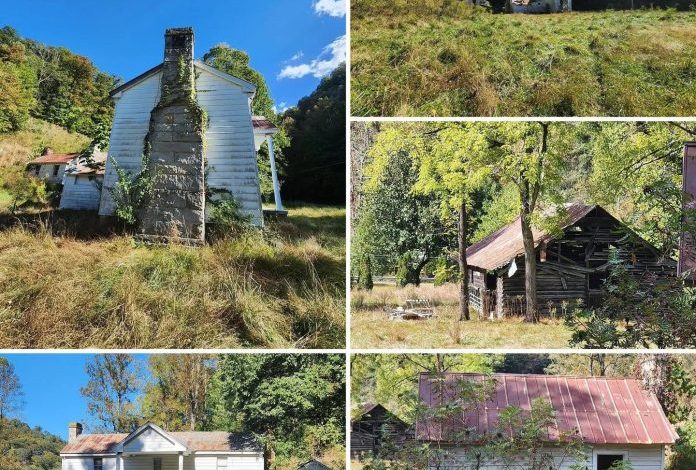
The exterior photographs reportedly show a white farmhouse in a grassy valley surrounded by wooded hillsides. A covered porch, metal roof, and prominent stone chimney contribute to its traditional rural appearance.
However, the visible condition suggests that significant maintenance may be required.
Interior photographs show stored materials and debris, damaged wall finishes, areas of deteriorated or missing ceiling material, and boarded windows. The bathroom also appears to have substantial deterioration around the sink and wall surfaces.
These images raise several questions that should be answered before a buyer commits to a restoration project.
Boarded windows: Buyers should determine whether the original frames and surrounding walls remain sound, whether water has entered the building, and whether replacement windows will be necessary.
Ceiling and wall damage: The source of the deterioration should be identified. Roof leaks, plumbing problems, condensation, and other moisture issues can cause damage that extends beyond visible surfaces.
Staircase condition: The wooden staircase and adjacent structures should be inspected for stability and safe access between floors.
Bathroom deterioration: The room may require substantial rehabilitation, including possible plumbing replacement and repairs to the surrounding walls and floor.
Stored materials and debris: The contents will need to be assessed and potentially removed before all areas can be inspected properly. Buyers should clarify what will remain with the property and who is responsible for removal.
These conditions suggest that the project could involve much more than fresh paint and new flooring. Structural safety, weatherproofing, utilities, and sanitation should take priority over cosmetic improvements.
A Historic Barn, Former Dairy Building, and Additional Outbuilding
The farmhouse is not the only structure included in the listing. The property reportedly contains a traditional barn, a former dairy building, and another outbuilding.
These structures help establish the property’s historic agricultural character. Depending on their condition, they could potentially serve as storage areas, workshops, or shelters for permitted agricultural uses.
Exterior photographs reportedly show a weathered wooden barn with sections of siding and roofing that appear deteriorated. However, photographs alone cannot establish whether the framing, supports, and foundations remain structurally sound.
Before entering or using any of the buildings, buyers should have them assessed for safety. Older agricultural structures may have weakened floors, unstable walls, damaged roof framing, or other hazards that are not obvious from outside.
Restoration costs can vary substantially depending on the extent of deterioration and the materials required. If a building cannot be repaired economically, demolition and debris removal may become additional expenses.
The property’s outbuildings should therefore be viewed as potential assets only after their condition and intended uses have been evaluated.
How Much of the 40.09 Acres Is Usable?
The listing describes a mixture of relatively level bottomland, rolling terrain, and wooded acreage. That combination may appeal to buyers who want both open space and natural surroundings.
The more level sections could potentially be useful for gardens, pasture, or other agricultural activities. The wooded areas may offer privacy and recreational opportunities.
However, the amount of acreage does not automatically establish how much land can be farmed, built upon, or easily accessed.
Low-lying bottomland can be attractive for certain uses, but drainage conditions and flood exposure should be investigated. Soil composition, slope, access routes, and the location of existing structures may also influence what can be done with the parcel.
The listing reportedly mentions creek or stream views, but this does not establish deeded waterfront frontage or any specific water rights. Buyers should confirm the location of any water features and whether they affect access, flood exposure, or land-use restrictions.
Before planning major improvements, prospective owners should review property boundaries, topographic information, available soil data, and relevant flood maps. A survey and site assessment may help establish which areas are practical for the intended use.
What Does the $100,000 Asking Price Mean Per Acre?
At an asking price of $100,000 for approximately 40.09 acres, the property works out to about $2,494 per acre.
The supplied information also implies a price of approximately $50 per square foot based on the reported 2,000-square-foot farmhouse.
Neither figure provides a complete valuation.
The per-acre calculation includes the existing buildings, while the price-per-square-foot figure assumes reported floor area that may not currently be usable as living space. Given the farmhouse’s condition, buyers should avoid treating that figure as a direct comparison with renovated homes.
A more meaningful assessment would compare recent sales of similar rural properties in Buchanan County, including parcels with older houses, deteriorated buildings, comparable acreage, and similar access conditions.
Buyers should consider both the potential value of the land and the cost of dealing with the existing structures. If the farmhouse requires extensive restoration or the outbuildings need major repairs, those expenses could significantly change the overall financial picture.
The asking price may justify further investigation, but it does not by itself establish that the property is underpriced.
Could the Property Become a Working Homestead?
The listing suggests that some of the more level ground could be suitable for gardens or farm animals. It also reports that horses are permitted.
For buyers interested in a rural homestead, the acreage and existing agricultural buildings could offer a starting point. However, a practical homestead requires more than land and structures.
Prospective owners should evaluate the quality of the soil, availability of usable pasture, fencing requirements, water access, drainage, and the condition of any potential animal shelters.
The supplied information does not report existing fencing, and the water system is not clearly identified. Both factors could affect the cost and feasibility of keeping livestock.
Buyers considering gardening should also determine whether the soil is appropriate for cultivation and whether the intended growing areas receive sufficient sunlight.
The listing identifies zoning as “None,” but that wording should not be interpreted as proof that all uses are permitted. Local requirements, building codes, environmental rules, deed restrictions, and other regulations may apply.
Before investing in agricultural improvements, buyers should confirm the property’s permitted uses with the relevant local authorities.
Water, Septic, Electricity, and Heating Remain Unclear
One of the most important questions concerns the property’s utilities.
The listing identifies water and sewer as “Other,” without clearly specifying whether the property has an active well, public water connection, or approved septic system. Heating and cooling are listed as absent, and natural gas is reportedly unavailable.
This uncertainty matters because restoring an older house can be significantly more complicated when its essential infrastructure is missing, damaged, or no longer approved for use.
Buyers should determine whether electricity is connected and whether the electrical system is safe. They should also establish whether a reliable water source exists and whether the property has a functioning wastewater system.
If a new well, septic system, or electrical service is required, the installation costs should be estimated before an offer is finalized.
Heating will require particular attention if the farmhouse is intended for year-round occupancy. Buyers should investigate suitable heating options, insulation requirements, and the condition of the building envelope.
The presence of an old house does not guarantee that its utility connections remain operational. Confirming these systems is essential to determining the property’s realistic restoration budget.
Renovation Costs: Why the Purchase Price Is Only the Beginning
The farmhouse’s reported condition is the largest source of financial uncertainty.
Depending on the inspection findings, the project could involve work on the foundation, framing, roof, windows, exterior siding, electrical wiring, plumbing, bathroom, kitchen, walls, ceilings, and flooring.
The property may also require debris removal, moisture remediation, pest treatment, and improvements to the water and wastewater systems.
Because the farmhouse reportedly dates to approximately 1890, buyers should consider the possibility of hazardous older building materials. Lead-based paint may be present, and certain older construction materials may contain asbestos. Their presence should not be assumed, but professional evaluation may be appropriate before demolition or renovation disturbs them.
The stone foundation and chimney also deserve careful attention. Their appearance may contribute to the property’s historic character, but a qualified professional should determine whether they are structurally sound and whether repairs are needed.
Costs will depend on the extent of deterioration, local labor rates, material choices, site access, and the standard of restoration.
Buyers should obtain written estimates from qualified contractors and include a contingency for unexpected work. If restoring the farmhouse is not economically practical, they should separately estimate the cost of demolition, disposal, and preparing a building site.
Financing a Property in Poor Condition
Traditional mortgage financing can be challenging when a house has substantial deterioration and no confirmed functioning heating, water, or sanitation systems.
Some residential loan programs require a property to meet minimum standards for safety, structural condition, and habitability. The home’s reported age and condition may therefore affect which financing options are available.
Depending on the buyer’s circumstances and the property’s eligibility, possible approaches could include a cash purchase, a suitable renovation loan, or a land-oriented financing product. Availability, down-payment requirements, and loan terms vary, and no option should be assumed to be available without lender approval.
Buyers should speak with lenders experienced in rural properties and distressed homes before making an offer. They should explain the building’s reported condition and the uncertainty surrounding its utilities.
Insurance is another important consideration. Coverage for an unoccupied house requiring substantial rehabilitation may be limited or more expensive than coverage for an occupied, maintained home.
Prospective buyers should obtain insurance guidance before closing and ensure that the proposed policy covers the property’s actual condition and intended use.
Flood Risk and Rural Road Access
The property reportedly includes low-lying land and views of a creek or stream. These features may contribute to the rural setting, but they also make drainage and flood-risk research important.
Buyers should review available flood maps, investigate the history of flooding on and around the parcel, and consult local authorities regarding floodplain requirements. A flood map is a useful starting point, but it may not capture every drainage or site-specific concern.
The listing also identifies the road surface as unimproved. Buyers should determine how the access route is maintained, whether there are recorded easements or road agreements, and whether the route remains passable during adverse weather.
Construction vehicles, emergency services, and contractors may need reliable access during restoration. If improvements to the road or driveway are necessary, those expenses should be included in the project budget.
Legal access and practical year-round access are not always the same. Both should be confirmed before the property is purchased.
Property Taxes and Long-Term Ownership Costs
The listing reports annual property taxes of approximately $200. Buyers should verify the current tax bill with Buchanan County and ask whether the assessed value or tax obligation could change after a transfer or subsequent improvements.
Taxes are only one component of ownership expenses.
Other costs may include insurance, debris removal, vegetation management, utility installation, building stabilization, equipment rental, road maintenance, and ongoing repairs to the farmhouse and outbuildings.
If the house cannot be occupied during restoration, buyers may also need to account for alternative accommodation and travel costs.
The large acreage may require ongoing maintenance even if the farmhouse is not restored immediately. Prospective owners should consider the time, equipment, and expense needed to maintain the land.
A realistic financial plan should cover the entire project rather than focusing exclusively on the $100,000 asking price.
Potential Advantages and Drawbacks
Potential advantages
- Approximately 40.09 acres offered for $100,000.
- Historic farmhouse with traditional rural architecture.
- Existing barn, former dairy building, and another outbuilding.
- A mix of relatively level, rolling, and wooded terrain.
- Potential for gardening or permitted agricultural uses.
- Rural setting near Grundy, Virginia.
- No homeowners association reported.
Important drawbacks
- The farmhouse has reportedly been vacant for many years.
- Interior and exterior conditions are rated poor.
- Photographs show visible deterioration and accumulated materials.
- Water and wastewater arrangements are unclear.
- No heating or cooling systems are reported.
- Agricultural buildings may require extensive repairs.
- The access road is described as unimproved.
- Flood exposure and drainage conditions need investigation.
- Conventional mortgage financing and insurance may be difficult to obtain.
- The farmhouse’s age and square footage are estimates rather than confirmed measurements.
Whether the advantages outweigh the drawbacks depends on the land’s actual condition and usability, the buildings’ structural integrity, and the buyer’s renovation budget.
Questions Buyers Should Ask Before Making an Offer
Before committing to the property, prospective buyers should seek answers to several important questions:
- Is the farmhouse structurally sound enough to restore?
- Has the stone foundation been evaluated by a qualified professional?
- Is the metal roof watertight, and what is its estimated remaining service life?
- Are electricity, water, and wastewater services currently available and functional?
- Are the barn and other outbuildings safe to enter or use?
- How much of the 40.09 acres is suitable for gardening, livestock, or construction?
- Does any portion of the property fall within a mapped flood hazard area?
- Is the access route legally established and adequately maintained?
- Are there easements, liens, deed restrictions, or other title issues?
- Are any mineral or timber rights included in the sale?
- Would restoration be more economical than demolition and replacement?
- What permits and approvals would be needed for the buyer’s intended use?
Independent inspections, title review, and verification with local authorities can help clarify these questions before a purchase becomes binding.
Final Thoughts: Is This $100,000 Virginia Property Worth Considering?
The property on Hobbs Branch Road near Grundy offers a distinctive combination of approximately 40 acres, a farmhouse dating to around 1890, and several traditional agricultural structures.
For buyers interested in historic rural properties, land ownership, or a substantial restoration project, the listing may be worth investigating. The mixture of open and wooded terrain could provide flexibility for different rural uses, subject to site conditions and local requirements.
However, the reported condition of the farmhouse and outbuildings creates substantial uncertainty. The absence of clearly documented utilities, visible interior deterioration, and unimproved road access could add considerably to the cost of making the property usable.
Rather than treating this as an inexpensive move-in-ready farmhouse, buyers should approach it as a potential restoration project or a land purchase with existing structures that may need extensive work.
A professional inspection, verified utility information, flood-risk research, title review, and realistic contractor estimates are essential to determining whether the property makes financial sense.
Ultimately, the land and historic farmstead may be appealing, but the right decision depends on the property’s verified condition, the buyer’s plans, and the full cost of ownership after the purchase.
This article is based on the supplied listing information. The asking price, estimated building details, property condition, utilities, acreage, access, taxes, and permitted uses should be independently verified with the listing agent, qualified professionals, and relevant authorities before purchase


Original Property Listing
Hobbs Branch Rd, Grundy, VA 24614
View the original Zillow listing